
Concerns  /  Lips and Lower Face  /  Upper Lip Lines

Upper lip lines: why they form
and how to get rid of them
The fine vertical lines running upward from the border of the upper lip are called perioral rhytides. Most people know them as lip lines, or by the name that causes the most confusion in this subject: smoker’s lines.
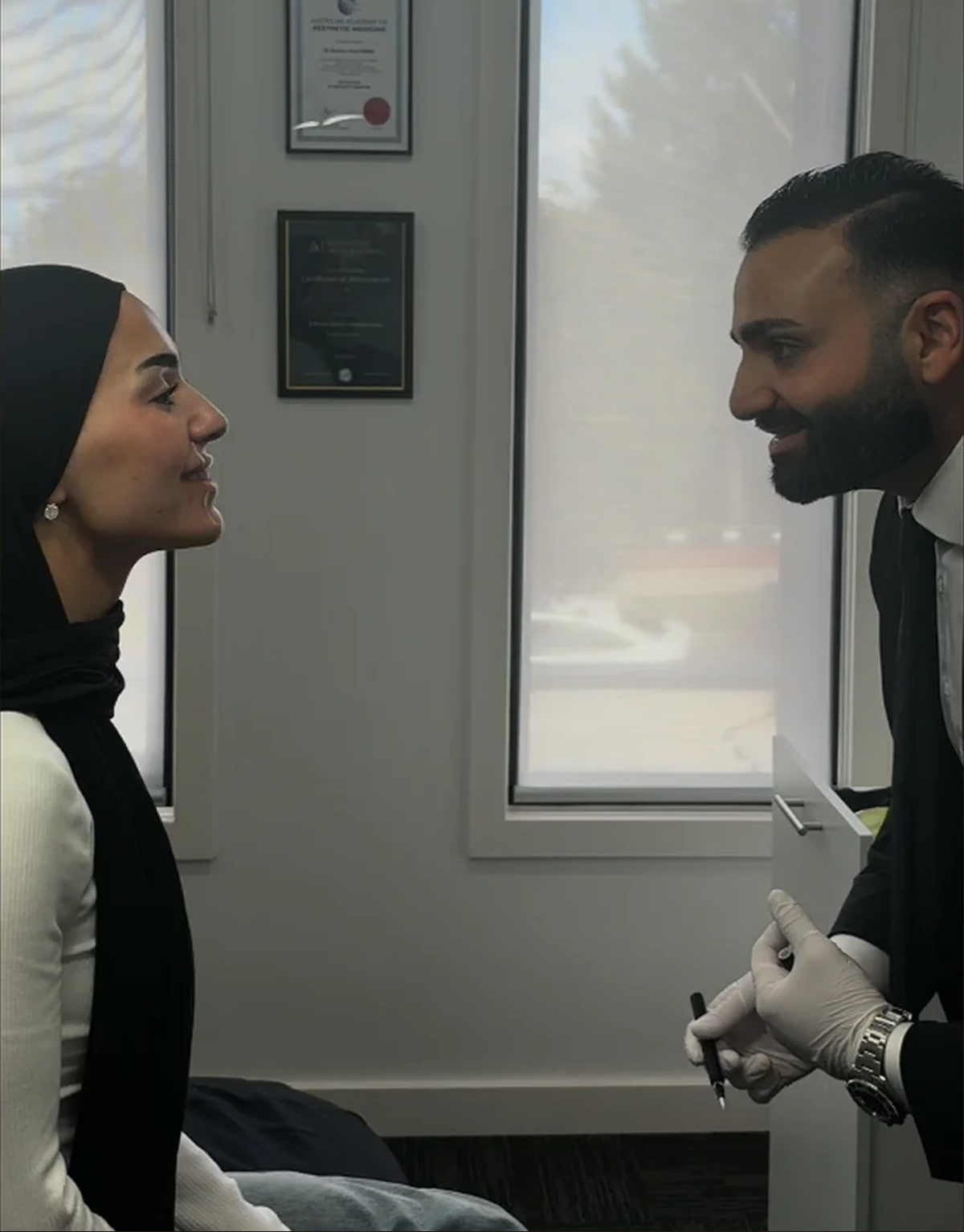
Dr Ibrahim Hawli
MBBS  ·  Registered Medical Practitioner
tajmeel-upper-lip-lines
In short
Upper lip lines are mostly not about smoking. They form because the skin above the upper lip has less collagen, less elastin, less fat and fewer oil glands than almost anywhere else on the face, and because it sits directly on a ring-shaped muscle that pleats it thousands of times a day. Bone loss in the upper jaw and lengthening of the philtrum reduce the support beneath it. Lines that appear only when you purse respond differently from lines visible at rest. No topical product removes an established line, and every approach that meaningfully changes one involves real downtime.
01  /  The Misconception

Why “smoker's lines”
is the wrong name

The name has done a lot of damage, in both directions. It makes non-smokers assume their lines must be something else, and it makes smokers assume the lines are punishment rather than anatomy.
The vast majority of patients presenting with perioral lines have never smoked. They have them because the orbicularis oris muscle works the same way in everyone, and because the skin above the upper lip is structurally disadvantaged from the outset.
Smoking does accelerate every one of the processes described below. But it is an accelerant, not a cause. Stopping smoking removes an active driver. It does not remove established lines.
02  /  Why This Skin

Why the skin above the upper lip
is uniquely vulnerable

A 2025 review of human lip ageing measured three separate structural disadvantages in this one small area.
01

Less collagen and elastin

Per square millimetre than the cheeks. The skin does not spring back after being folded.
02

Less subcutaneous fat

Than the forehead. Little cushioning beneath to hold the surface smooth.
03

Fewer oil glands

Than virtually anywhere else on the face. The barrier dries out faster and is less resilient to everything, including the products applied to it.
Thin skin with little structural reinforcement, sitting on a muscle that never stops working, is a line waiting to happen.
03  /  The Mechanism

The muscle underneath is a
sphincter, not a strap

This is the part most explanations miss, and it is the reason this area behaves unlike the rest of the face.
Most facial muscles are strap muscles. They pull in one direction, and the lines they produce run perpendicular to that pull. The orbicularis oris is not a strap. It is a sphincter, a ring encircling the mouth, and when it contracts it draws inward from every direction at once. That gathers and pleats the thin skin above the lip rather than simply folding it.
It happens constantly. Every word spoken. Every sip from a cup or a straw. Every kiss. Every smile. Vowel sounds like “oh” and “ooh” purse it directly, which means an ordinary conversation involves hundreds of contractions.
Histological studies comparing younger and older upper lips also show the orbicularis oris itself atrophies with age. So the muscle becomes thinner while continuing to do the same work on skin that is also becoming thinner.
04  /  Below the Surface

What changes beneath the skin:
bone, philtrum and muscle

Three deeper changes reduce the support the skin sits on. None is visible, and none can be addressed at the surface.
This is why a page that only discusses the surface is incomplete. Some of what a patient sees is happening several layers down.
Layer one

Bone

Selective bony resorption occurs in specific areas of the facial skeleton, including the maxilla. As the upper jaw retrudes and the piriform aperture at the base of the nose widens, the foundation beneath the lip reduces.
Layer two

The philtrum

The distance between the base of the nose and the lip border lengthens with age. The skin therefore has farther to travel and less structure to sit on.
Layer three

The muscle's shape

Within the orbicularis oris, the curvature relaxes over time, which results in an overall increase in lip length.
The combined effect is that the upper lip flattens and lengthens, the vermilion rolls inward, and the skin above it has more distance to cover with less beneath it.
05  /  The Key Distinction

Dynamic or static:

the difference that decides everything
Two people can describe identical lines and have entirely different situations.
State one

Dynamic

Appear when you purse your lips and disappear when your face is at rest. The skin is still elastic enough to unfold. These respond to reducing the mechanical load and improving dermal quality.
State two

Static

Visible when your face is completely relaxed. The crease is now etched into the dermis. Reducing muscle activity slows further deepening but does not remove what is already there.
Try this in a mirror
Relax your face completely and look at the skin above your lip. Then purse as though whistling. If the lines only appear on pursing, they are dynamic. If they are visible in both states, you have static change, and probably a combination.
Most people presenting in their forties and fifties have both. Knowing the proportion is what makes an expectation realistic rather than optimistic.
06  /  Evidence

Upper lip wrinkles home remedies:
what has evidence and what does not

This is asked constantly and answered badly. Here is the honest separation.
Has reasonable evidence
Topical retinoids
Retinoids activate nuclear retinoic acid receptors in fibroblasts, upregulating the genes responsible for collagen I and collagen III. Over weeks to months the dermal collagen matrix thickens, giving more structural resistance to creasing. One study evaluating a topical serum on perioral rhytides found measurable improvement in line depth and texture.
Daily sun protection
Ultraviolet exposure degrades the collagen and elastin that let skin unfold and spring back. Extend facial sunscreen to the full perioral area rather than stopping at the lip margin, and use a lip balm with SPF for the lips themselves.
Stopping smoking
Removes an active accelerant.
Vitamin C
Antioxidant protection and support for collagen synthesis.
No meaningful evidence for established lines
Facial massage or facial exercises
None of these is harmful. None will change a line already etched into the dermis.
Lip taping
As above.
Coconut oil, olive oil, petroleum jelly
Useful as basic barrier support. Nothing beyond that.
Vitamin E oil, sleeping position, extra water
Beyond correcting genuine dehydration, no meaningful effect on established lines.
One warning about retinoids here. The thin perioral skin is prone to irritation from conventional retinol. Redness, flaking and dryness can actually accentuate the appearance of lip lines in the short term. Start at a low strength, apply infrequently at first, and discuss it with a doctor rather than guessing.
07  /  The Honest Answer

How to get rid of vertical lip lines
naturally, and the limits of that

You can slow the formation of new lines considerably, and you can improve the quality of the skin they form in. Consistent retinoid use, daily sun protection, not smoking and a well-supported barrier will all do that, over months rather than weeks.
You cannot remove an established static line by any topical or natural means. A crease etched into the dermis is a structural change in the tissue, and nothing applied to the surface reaches it.
That is not a sales position. It is the reason the honest sections above are worth reading before you spend anything.
08  /  The Options

Best non surgical treatment for upper
lip lines: what each category can do

Four categories of approach exist for this area. They do different things, and none of them does everything. Most established cases benefit from a staged combination rather than one thing, and the sequence matters.
01

Skin-directed care

Improves dermal quality, thickness and texture over months. Slows new line formation.
Does not remove established lines.
02

Reducing muscle activity

Reduces the mechanical pleating that creates dynamic lines.
Because the muscle controls speech and lip seal, the approach here is conservative by necessity. Assessment establishes whether it is appropriate at all.
03

Resurfacing and energy-based

Work on the dermis itself by creating controlled injury that stimulates collagen remodelling. The category most relevant to established static lines.
Availability and suitability are established at consultation.
04

Volume and structure

Relevant where the concern is lip proportion or lost support rather than the lines themselves.
Assessment establishes which of the two is driving what you have noticed.
Surgical options exist and are not performed here. Where a lip lift or another surgical approach is the appropriate course, referral to an appropriate specialist is the recommendation.
09  /  The Trade

Laser resurfacing for upper lip lines,
and what downtime actually means

Resurfacing approaches work by creating controlled micro-injury in the dermis, which stimulates a healing response and new collagen formation. Ablative carbon dioxide lasers remove the surface epidermis layer by layer. Fractional approaches treat columns of tissue and leave intervening skin intact.
The mechanism is sound and this is the category with the most direct effect on established static lines. What is usually left out is the trade.
7 to 10
Days before makeup
After deep peeling or full ablative resurfacing of the upper lip.
Weeks
To months of pinkness
Gradually fading, throughout which sun protection is non-negotiable.
Skin type
Changes the plan
Aggressive peels carry pigmentation risk, particularly in skin tones outside the lightest range.
That is not a complication. That is the expected course.
Energy-based approaches are generally more predictable and more controllable than aggressive peels, which is why skin type is part of the assessment rather than an afterthought. Patients who understand the trade before they start are consistently the most satisfied.
10  /  Assessment

What an upper lip lines
treatment assessment covers

Photographs may be taken as a clinical record and are not used for advertising.
11  /  Before You Decide

What to know before
your consultation

Every option carries potential risks as well as potential benefits, and no cosmetic medical procedure is risk free. In this area the specific considerations are that the muscle involved controls speech and lip seal, and that the skin is unusually thin, which affects both healing and the visibility of any surface change.
Bring a list of your current medications, your current skincare products, and tell your doctor about any history of cold sores or previous resurfacing.
Assessed at consultation

Factors that may make an approach inadvisable

Individual results vary. Not all people are suitable candidates. In some cases the appropriate recommendation is that nothing be undertaken.
12  /  What Happens

What happens at your consultation in Glenroy

Appointments run 30 to 45 minutes. A consultation fee applies and is confirmed when you book. No referral is required to attend.
01

Discussion

What you have noticed, how long it has been present, smoking and sun history, medical history, current medications, current skincare and any previous cosmetic work.
02

Assessment

The perioral area is examined at rest, on pursing, in speech and in full smile, with palpation for skin thickness and support, and assessment of skin type.
03

Information

Whether your lines are dynamic, static or mixed, what is clinically appropriate, what the recovery involves realistically, risks, alternatives and the option of proceeding with nothing.
04

Decision

You are not asked to decide on the day. Time to consider information is part of informed consent.
13  /  Service Area

Upper lip lines treatment near me:
assessment across Melbourne's north

The clinic is on Glenroy Road, close to Glenroy Station and the Pascoe Vale Road corridor. Patients attend from Glenroy, Hadfield, Fawkner, Oak Park, Gowanbrae, Pascoe Vale, Coburg North, Broadmeadows, Campbellfield and Craigieburn.
14  /  Common Questions

Questions patients
ask

If your question is not answered here, ask it at your consultation. There is time set aside for exactly that.

Yes, and most people with them have never smoked. The lines form because the ring-shaped muscle around the mouth pleats unusually thin skin thousands of times a day. Smoking accelerates the process but does not cause it on its own.

Established static lines can be substantially improved but not reliably erased. Dynamic lines that appear only on pursing respond better. Any approach that meaningfully changes an etched line involves real downtime, and anyone promising removal without it is overstating what is achievable.

There is no single best one, because the categories address different things. Skin-directed care improves dermal quality. Reducing muscle activity addresses dynamic lines. Resurfacing addresses established static lines. Most established cases benefit from a staged combination, and the right sequence depends on examination.

Retinoids, daily sun protection, vitamin C and stopping smoking have reasonable evidence behind them and are worth doing. Facial massage, lip taping, oils and vitamin E have no meaningful evidence for established lines. None of the latter is harmful, but none will change a line already etched into the dermis.

You can slow new lines forming and improve the skin they form in, using consistent retinoid use, daily sun protection including the lip border, and not smoking. You cannot remove an established line by topical or natural means, because the change is structural and sits below the surface.

Resurfacing works on the dermis by creating controlled injury that stimulates collagen remodelling, and it is the category with the most direct effect on established static lines. The trade is recovery: roughly a week to ten days before makeup, then weeks to months of fading pinkness and strict sun protection.

The thin perioral skin is prone to irritation from conventional retinol. Redness, flaking and dryness can accentuate the lines temporarily. Starting at a low strength and applying infrequently at first usually settles it, and it is worth discussing rather than guessing.

A consultation fee applies and is confirmed when you book.

Related concerns

The perioral area is assessed as a whole

Lower perioral region
Structural region
Perioral region
Dermal assessment
Dr Ibrahim Hawli
Written and clinically reviewed by
Dr Ibrahim Hawli, MBBS
Level 1 Certification, American Academy of Aesthetic Medicine. Advanced training in non-surgical nasal work with Aesthetic Intelligence.
Last reviewed: [insert month year]  ·  Next review due: [insert month year]

Your first step is

an assessment.
This page provides general information about cosmetic medical consultations and does not constitute medical advice. Any cosmetic medical procedure carries risks. Individual outcomes vary and not all people are suitable candidates. Surgery is not performed at this practice. Any decision follows an individual consultation and assessment with a registered medical practitioner.