
Concerns  /  Lips and Lower Face  /  Marionette Lines

Marionette lines: why they form
between two fixed points
Marionette lines run downward from the corners of the mouth toward the jawline. Most people notice them because their face looks like it is frowning when it is not.
The name comes from puppet theatre. What the research explains best is why the line appears exactly where it appears, which turns out to be a question with a precise answer.
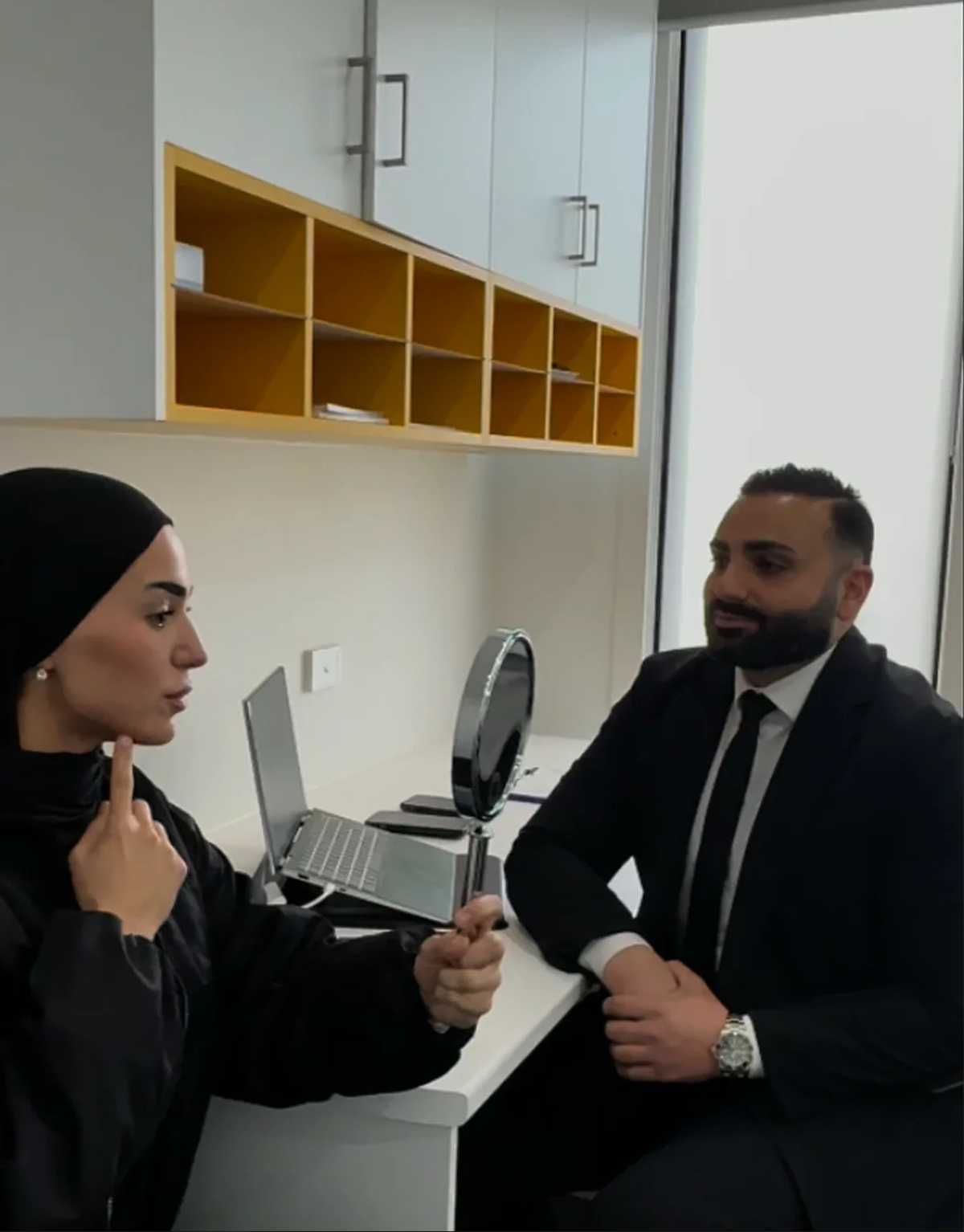
Dr Ibrahim Hawli
MBBS  ·  Registered Medical Practitioner
tajmeel-marionette-lines
In short
A marionette line forms in the space between two anchored points. Above, the depressor anguli oris muscle attaches into the skin at the labiomandibular crease. Below, the mandibular ligament tethers skin to bone. The tissue between those two fixed points is what moves with age and expression, and the fold is the result. The ligament also stops jowl fat descending past it, so tissue piles up above the line while the area below stays sparse, which is why the line reads deep. Seven separate factors contribute.
01  /  The Name

Why they are called
puppet lines

The name comes from European puppet theatre. The pattern resembles the hinged mouth corners of a marionette, where the jaw section is a separate piece with a visible seam running down from the corner of the mouth. The precise origin of the term is unclear, but the resemblance is obvious once you have seen it.
Puppet lines and marionette lines describe the same thing. So does the clinical name, which is more useful.
The static labiomandibular fold
Labio for lip, mandibular for jaw, and static because it is present even in an expressionless face. That last word carries the important information. A line that is only there when you pull an expression is a different finding from one that is there when your face is completely still, and they are not managed the same way.
02  /  The Mechanism

The fold forms

between two fixed points
A cadaver study examined the anatomy of this fold in twelve fresh hemifacial dissections, using methylene blue dye staining, histological evaluation and gross dissection. All three methods confirmed the same thing: the fold has distinct anatomical boundaries.
Upper boundary

Depressor anguli oris

The cutaneous insertion of the muscle at the labiomandibular crease. The muscle attaches directly into the skin there.
Lower boundary

The mandibular ligament

A ligament that tethers skin to the jawbone.
Both act as relative points of fixation. They do not move. The dynamic forces of ageing and facial animation then act about those two fixed points, and the fold is what forms between them.
That is why the line sits where it does. It is not a random crease. It is the visible edge of a zone bounded above by a muscle attachment and below by a ligament, with mobile tissue in between that has nowhere to go.
The researchers noted this is consistent with the anatomy of other facial folds, including the nasolabial fold, which forms by the same principle in a different location.
03  /  Two Findings, One Name

Static and dynamic:
two folds, one name

Two distinct findings carry the same label, and the distinction changes the answer. Many people have both. Some have only the dynamic version and are told they have marionette lines, which is not quite accurate and leads to the wrong expectation.
Finding one

The static labiomandibular fold

The marionette line proper. Present at rest, in an expressionless face. It is a structural change.
Finding two

The dynamic labiomandibular fold

Forms along the anterior border of the depressor anguli oris during facial expression. It appears when the muscle contracts and softens when it relaxes.
Test it in a mirror
Let your face go completely still and look at the area between the corner of your mouth and your jaw. Then pull the corners of your mouth downward deliberately. If the line only appears on the second, it is dynamic. If it is visible in both, the structural fold is established.
04  /  Causes

What causes marionette
lines to deepen

The clinical literature lists seven contributing factors, and most people have several. Seven is unusual for a single facial feature. It is also why one approach rarely addresses a marionette line fully, and why the literature describes these as multifactorial.
01

Bone resorption

In the upper and lower jaw. The foundation beneath the soft tissue reduces.
02

Gravitational descent

Tissue moves downward over time.
03

Deep fat reduction

The fat layer directly beneath the depressor anguli oris thins.
04

Muscle compression

The depressor anguli oris itself changes with repeated use.
05

Ligament tethering

The anchor holding the lower boundary becomes more visible as everything around it moves.
06

Skin and tissue laxity

Sagging of redundant skin and connective tissue with age.
07

Jowl and buccal fat descent

Fat from above arrives at the line and stops there.
05  /  The Contrast

Why the jowl builds above the line
and the area below empties

This explains the visual, and it is more specific than “sagging”.
The ligament at the lower boundary does not just tether skin. It also impedes further downward and inward displacement of the jowl fat compartment. Fat descending from above reaches that point and stops. Meanwhile, the superficial fat found between the two folds is scarce to begin with.
So you get fullness on one side of the line and sparseness on the other. The fold reads as deep not only because of the crease itself but because of the contrast in volume across it.
The extended part of the fold, in front of the jawline, diminishes while the tissue above it protrudes. That difference is what produces the prejowl sulcus.
06  /  Rarely Explained

Why humans develop
jowls at all

This is not on any consumer page and it reframes the subject.
Jowls develop as a consequence of ageing acting on a functional adaptation of the human mouth.
To open the jaw wide while keeping the corners of the mouth relatively narrow, the tissue lying over the mandible immediately beside the commissure must be hypermobile. That mobility exists entirely in the subcutaneous layer, which allows the jawbone to move largely independently of the overlying skin.
In other words, the tissue in that zone is loose by design, because you need it to be in order to speak, chew and open your mouth.
Age acts on that designed looseness. The jowl is not a defect. It is the long-term consequence of a functional requirement, which is why it is close to universal and why prevention has limits.
07  /  The Jaw Border

The prejowl sulcus, and why
the jaw looks uneven

Patients often describe the jawline looking wavy or uneven rather than describing a line at all.
The prejowl sulcus is the shallow dip that forms in front of the jowl, along the border of the jaw. It occurs because the extended part of the fold in front of the jawline reduces in volume while the tissue above it stays full and protrudes. The result is a jawline with a dip and then a bulge, rather than a continuous line.
This matters clinically because the marionette line and the prejowl sulcus are frequently addressed as one problem when they are two connected findings, and because an assessment that looks only at the line and not at the jaw border is incomplete.
08  /  Why Examination Matters

A landmark that
can be felt

There is a specific structure here that a practitioner should be able to locate by hand. The mandibular osseocutaneous ligament, whose distal fibres interweave with the depressor anguli oris to form the lower quadrant of the marionette line.
5.6 cm
From the jaw angle
Approximate distance from the gonial angle.
1 cm
Above the jaw border
Approximate height above the lower border of the mandible.
3.6 mm
Ligament width
The approximate span of the structure itself.
It can be palpated clinically as the tethering point between the anterior jowl and the marionette line.
That is worth knowing as a patient, because the anatomy here is not theoretical. There is a fixed structure that can be located on your face, and its position relative to your jowl and your line is part of what an assessment establishes. It is also the reason a photograph is inadequate for this region. A tethering point cannot be photographed. It has to be felt.
09  /  Individual Anatomy

Anatomy is not
identical in everyone

The modiolus is the point where several perioral muscles converge, just lateral to the corner of the mouth. It is a structural hub, and its position varies.
Research in Asian populations places it approximately 11 mm lateral and 9 mm below the oral commissure. That lower and more lateral position is described as predisposing to downturning of the mouth corner and to line formation, even at rest.
The practical point is not the numbers. It is that a single standard diagram does not describe every face, and that the position of the muscular hub in your face influences both how the line formed and what is appropriate. Assessment is individual for anatomical reasons, not just as a matter of courtesy.
10  /  Assessment

What a marionette lines
treatment assessment covers

Photographs may be taken as a clinical record, in standard front, oblique and side views, and are not used for advertising.
11  /  Before You Decide

What to know before
your consultation

Every option carries potential risks as well as potential benefits, and no cosmetic medical procedure is risk free. In this region the specific considerations are that the muscles here control the position of the mouth corner and contribute to expression, and that the facial artery and its branches run through the lower face.
Bring a list of your current medications, and a photograph from several years ago if you have one.
Where established jowling and skin laxity are the dominant findings, a surgical opinion addresses the cause. Surgery is not performed at this practice, and referral is the recommendation in those cases.
Assessed at consultation

Factors that may make an approach inadvisable

Individual results vary. Not all people are suitable candidates. In some cases the appropriate recommendation is that nothing be undertaken.
12  /  What Happens

What happens at your consultation in Glenroy

Appointments run 30 to 45 minutes. A consultation fee applies and is confirmed when you book. No referral is required to attend.
01

Discussion

What you have noticed, when it changed, any recent weight change, dental history, medical history, current medications and previous cosmetic work.
02

Assessment

The lower face is examined at rest and in animation, with palpation of the tethering point, assessment of jowl formation, jaw border continuity, skin quality and chin projection.
03

Information

Whether your fold is static, dynamic or mixed, which of the contributing factors dominate, what is clinically appropriate, whether referral is the better course, risks, alternatives and the option of proceeding with nothing.
04

Decision

You are not asked to decide on the day. Time to consider information is part of informed consent.
13  /  Location

Marionette lines treatment in
Melbourne: where the clinic is

For anyone searching for marionette lines treatment in Melbourne, the practice is in Glenroy, in the City of Merri Bek, roughly 13 kilometres north of the central business district.
The clinic is on Glenroy Road, close to Glenroy Station on the Craigieburn line and the Pascoe Vale Road corridor. Patients attend from Glenroy, Hadfield, Fawkner, Oak Park, Gowanbrae, Pascoe Vale, Coburg North, Broadmeadows, Campbellfield and Craigieburn.
Assessment is by appointment. No referral is required to attend.
14  /  Common Questions

Questions patients
ask

If your question is not answered here, ask it at your consultation. There is time set aside for exactly that.

The same thing as marionette lines. The name comes from European puppet theatre, because the pattern resembles the hinged mouth corners of a marionette. The clinical term is the static labiomandibular fold, static because the line is present even in an expressionless face.

Because the area is bounded by two fixed points. Above, the depressor anguli oris muscle inserts into the skin at the labiomandibular crease. Below, the mandibular ligament tethers skin to bone. Those two do not move, and the tissue between them does, so the fold forms in that zone.

No, but they are connected. A jowl is descending tissue that stops at the ligament. The marionette line is the fold that forms in the zone above and beside it. The ligament prevents the jowl fat descending further, so tissue builds above the line while the area below stays sparse.

That is likely a prejowl sulcus. The fold in front of the jawline reduces in volume while the tissue above it stays full, producing a dip and then a bulge along the jaw border rather than a continuous line.

Only partly. The mobility of the tissue in this zone is a functional requirement, because the jaw needs to open wide while the mouth corner stays narrow. Age acts on that designed looseness. Sun protection and not smoking slow the skin component, but the mechanism itself is anatomical.

The corner of the mouth can sit downturned at rest, which reads as a negative expression the face is not making. That is a separate finding from the fold itself, driven by the position of the mouth corner and the activity of the muscle that pulls it down. Both are assessed.

Because there is a tethering point between the jowl and the line that can be located by hand and not by photograph, and because whether your fold is static or dynamic changes the answer entirely.

A consultation fee applies and is confirmed when you book.

Related concerns

The lower face is assessed as a whole

Structural region
Contour region
Mentalis region
Perioral region
Dr Ibrahim Hawli
Written and clinically reviewed by
Dr Ibrahim Hawli, MBBS
Level 1 Certification, American Academy of Aesthetic Medicine. Advanced training in non-surgical nasal work with Aesthetic Intelligence.

Last reviewed: [insert month year]  ·  Next review due: [insert month year]

Your first step is

an assessment.
This page provides general information about cosmetic medical consultations and does not constitute medical advice. Any cosmetic medical procedure carries risks. Individual outcomes vary and not all people are suitable candidates. Surgery is not performed at this practice. Any decision follows an individual consultation and assessment with a registered medical practitioner.