
Concerns  /  Lips and Lower Face  /  Jaw Clenching

Clenching jaw: why it happens,
and what actually helps
Clenching or grinding the teeth has a medical name, two distinct forms, and a cause that the science has recently changed its mind about.
It is also one of the few concerns where the most important step is seeing the right practitioner, and for the diagnosis itself, that practitioner is a dentist.
Dr Ibrahim Hawli
MBBS  ·  Registered Medical Practitioner
Jaw Clenching
In short

Jaw clenching and grinding is called bruxism, and it comes in two forms: awake bruxism, which is sustained clenching linked to stress and concentration, and sleep bruxism, which is rhythmic grinding tied to sleep arousal patterns. It is no longer thought to be caused by how your teeth meet. Diagnosis and dental management belong to a dentist, and where clenching disturbs your sleep it can point to a sleep breathing problem that needs medical assessment. The one area a cosmetic practice contributes to is the masseter, the chewing muscle that enlarges with chronic clenching and can widen the lower face.

01  /  The Condition

What jaw clenching is,
and its medical name

The medical term is bruxism. It describes repetitive activity of the chewing muscles: clenching, which is forced, static closure of the jaw, and grinding, which is forced, dynamic movement of the jaw with the teeth in contact.
Estimates of how many people experience it range from 8 to 10 per cent as an ongoing condition in adults, up to the majority of the population if you include everyone who clenches or grinds occasionally.
It is described clinically as a parafunctional activity, meaning an activity of the chewing system that serves no functional purpose. Chewing food is functional. Clenching under stress is not, and the forces involved can exceed what the teeth, muscles and jaw joint are built to absorb.
Where those forces exceed what the system can adapt to, the consequences follow: tooth wear, tooth sensitivity and fracture, jaw muscle pain and enlargement, headaches, and strain on the temporomandibular joint.
02  /  Two Conditions

Awake and sleep bruxism

are two different things
This is the distinction most content misses, and it changes everything about cause and management.
Form one

Awake bruxism

Repetitive or sustained clenching during the day. Usually clenching rather than grinding, associated with stress, anxiety and concentration. Its defining feature is that people do it without realising. One study found it present in nearly 70 per cent of a group where any bruxism was reported.
Form two

Sleep bruxism

Rhythmic or non-rhythmic activity of the chewing muscles during sleep, more often involving grinding. Tied to the micro-arousals that punctuate normal sleep, and understood as part of the transition between sleep and wakefulness rather than a conscious behaviour.
Some people have both. But the two are driven differently. Awake bruxism is a stress and habit pattern you can, with awareness, begin to interrupt. Sleep bruxism happens beyond conscious control and is managed differently, usually with a dental device and attention to sleep.
Knowing which one you have is the first step, and it is part of why a proper assessment matters rather than a generic instruction to stop clenching.
03  /  A Recent Shift

It is not about your bite,
and that is a recent change

For a long time, bruxism was blamed on the bite: on occlusal problems, meaning the way the upper and lower teeth meet, and on the shape of the jaw.
That understanding has changed. Recent studies suggest that occlusal discrepancies and craniofacial anatomical anomalies have minimal influence on the development of bruxism. The current view is that bruxism, particularly the sleep form, is generated centrally, by the nervous system, as part of the sleep-wake cycle, rather than locally by the teeth.
This matters for two reasons. First, grinding your teeth is not a sign that your teeth are wrongly shaped, and it usually cannot be fixed by adjusting them. Second, it directs attention to the actual drivers, which are stress, sleep and the nervous system, rather than to the bite.
It is one of the clearer examples of medical understanding shifting, and most consumer content is still working from the old model.
04  /  Drivers

What actually
drives clenching

If not the bite, then what. The current evidence points to several connected drivers. What connects all of these is that clenching is an output of the nervous system under load, not a mechanical fault of the mouth.
01

Stress and emotional state

The strongest and best-established association, particularly for awake bruxism. Multiple studies link clenching to stress, anxiety, panic and restlessness. Concentration counts too: many people clench while focused on a task, driving, or working.
02

The nervous system and sleep arousal

Sleep bruxism is tied to the brief arousals that occur naturally through the night. It sits within the machinery of sleep regulation rather than being a dental event.
03

Hormonal and neurotransmitter factors

Recent work emphasises the roles of cortisol, the stress hormone, and melatonin, which regulates sleep. Both fit the stress and sleep picture.
04

Certain medications and substances

Some medications, along with caffeine, alcohol and nicotine, are associated with increased bruxism. Worth reviewing with a doctor.
05  /  Symptoms

Jaw clenching symptoms,
and what each one means

Clenching produces a recognisable set of symptoms, and each one points at a different part of the problem. Knowing which you have is useful information to bring to an appointment.
Jaw muscle fatigue or aching
The muscle has been working. Worst in the afternoon suggests daytime clenching. Worst on waking suggests it is happening in your sleep.
Tenderness at the angle of the jaw or in front of the ears
Muscle soreness from sustained contraction. Tenderness specifically in front of the ear can also involve the joint itself.
Joint involvement: dental or physiotherapy
Headache in the temples or on waking
The temporalis is also a chewing muscle, and it runs across the side of the head. Clenching loads it along with the masseter.
Tooth sensitivity, or teeth that look flat
Enamel wear from grinding. This one needs a dentist, because it is damage rather than discomfort and it does not reverse.
See a dentist
Teeth that ache or feel loose
Sustained force transmitted through the teeth into the supporting structures.
See a dentist
A ridge inside the cheek, or scalloped tongue edges
Physical evidence of pressing soft tissue against the teeth. You can check for both in a mirror.
Clicking, locking or difficulty opening wide
These involve the jaw joint rather than the muscle.
Dental, oral medicine or physiotherapy
A lower face that has become wider or squarer
Muscle enlargement rather than a symptom of discomfort. This is the one that brings people to a cosmetic assessment.
Neck and shoulder tightness
Often present alongside, because the muscle pattern rarely stays confined to the jaw.
If several of these describe you, a dental assessment is the appropriate starting point, because it establishes whether your teeth are being damaged. That is not something to leave running.
06  /  Check Yourself

The signs you are clenching
without knowing

Because awake bruxism is defined by lack of awareness, most people who do it do not know until something points it out.
The tongue and cheek signs are particularly useful because they are physical evidence, and you can look for them in a mirror right now.
If several of these describe you, clenching is likely, and the appropriate next step is a dental assessment to confirm it and check for tooth damage.
07  /  Where This Practice Fits

Why chronic clenching
squares the jaw

This is the part of the picture where a cosmetic medical practice legitimately contributes, and it is worth understanding on its own terms.
The masseter is the main chewing muscle. It runs from the cheekbone down to the angle of the jaw, and you can feel it bulge if you place your fingers there and clench. Like any muscle, it responds to repeated heavy use by enlarging. That is masseter hypertrophy.
Chronic, forceful clenching, hour after hour, day after day, trains the masseter the way repeated exercise trains any muscle. Over time it thickens. Because it sits at the angle of the jaw, an enlarged masseter widens the lower face and gives it a squarer, heavier appearance.
For some people this is the reason they arrive: not the grinding itself, but the change in the shape of their lower face. A jaw that has widened over years of clenching is a soft-tissue change layered on top of the underlying bone, and it is assessed differently from the bruxism that caused it.
The two are connected. The clenching is the behaviour; the enlarged muscle is one of its consequences. Addressing the appearance without acknowledging the behaviour, or the tooth wear it may be causing, would be incomplete, which is why a dental assessment runs alongside.
08  /  Safety

When jaw clenching is a
sign of a sleep problem

This is a genuine safety point and it is almost never made clearly.
Sleep bruxism is linked to the arousal patterns of sleep, and to sleep disorders including obstructive sleep apnoea, where breathing is repeatedly interrupted during the night.
See a doctor if you also have
If you grind your teeth at night and any of these apply, the grinding may be the visible edge of a sleep breathing problem. That matters considerably more than the tooth wear, and it needs proper assessment.
The appropriate route is a conversation with a general practitioner, who can arrange a sleep assessment where indicated. Treating the grinding without recognising an underlying sleep disorder addresses the symptom and leaves a more important problem unassessed.
09  /  The Options

What clenched jaw
treatment actually involves

Because this is what people search, it is worth setting out honestly what the options are and who provides each one. Most of them are not cosmetic.
Read the list and notice the proportion. Most of what genuinely helps a clenched jaw is dental, medical or physiotherapy. One item is cosmetic, and it addresses a consequence rather than the cause.
01

A dental occlusal device

Usually the first and most important step. A custom fitted splint protects the teeth from further wear and, because it shows where the contact is happening, helps confirm the diagnosis. A shop bought mouthguard is not the same thing and can alter your bite if it fits badly.
Dentist
02

Addressing the driver

For awake clenching the driver is usually stress and habit. The most effective interventions work on awareness and on the stress itself, including simple habit interruption such as checking your jaw position several times a day.
GP or psychologist
03

Sleep assessment

Where the clenching happens at night, particularly alongside snoring or waking unrefreshed, a sleep assessment can identify a breathing problem driving the arousal pattern.
GP referral
04

Physiotherapy or oral medicine

Where the jaw joint is involved, meaning clicking, locking or restricted opening, or where there is significant muscle pain, these practitioners have the relevant scope.
Physiotherapist or oral medicine
05

Reducing an enlarged chewing muscle

Where years of clenching have enlarged the masseter and widened the lower face, the muscle can be assessed and addressed. This changes the appearance rather than the behaviour.
This practice
06

Review of medications and stimulants

Some medications, along with caffeine, alcohol and nicotine, are associated with increased clenching.
GP
That is the honest position, and it is why this page directs so much of the subject elsewhere.
10  /  Scope

Why a dentist is
central to this

It is worth being direct about this, because it is what makes the rest of the page trustworthy.
Bruxism is diagnosed by a dentist. The intraoral examination, looking for the specific wear facets on the teeth, the cheek and tongue signs, tooth fractures and sensitivity, is a dental examination. The occlusal splint or night guard, which both helps confirm the diagnosis and protects the teeth from further damage, is a dental appliance, fitted by a dentist.
If you clench or grind, a dentist is the practitioner who confirms it, assesses the damage to your teeth, and provides the device that protects them. That is not something a cosmetic practice does or should claim to do.
11  /  The Boundary

Where a cosmetic assessment fits

Given all of the above, the honest scope of what this practice contributes is specific and narrow.
Where chronic clenching has enlarged the masseter and widened the lower face, and where the appearance of that is a concern, the muscle can be assessed. That assessment considers the size and activity of the masseter, the symmetry between the two sides, the degree to which it is contributing to lower-face width, and how it sits within the overall proportion of the face.
This practice contributes to one specific consequence of clenching, the enlarged muscle, while directing the diagnosis and dental management to a dentist and any sleep concern to a doctor. That division is deliberate and it is correct.
12  /  Assessment

How jaw clenching
is assessed

Photographs may be taken as a clinical record, in standard views, and are not used for advertising.
13  /  Before You Decide

What to know before
your consultation

Every medical approach carries potential risks as well as potential benefits, and none is without risk. In this region the muscles are involved in chewing and jaw function, which is why any approach is conservative and assessed in person.
Bring a list of your current medications, details of any dental assessment or night guard you already have, and your answers to the self-awareness cues above.
Assessed at consultation

Factors that are relevant

Individual results vary. Not all approaches suit all people. In some cases the appropriate recommendation is a dental or medical assessment rather than anything undertaken here.
14  /  What Happens

What happens at your consultation in Glenroy

Appointments run 30 to 45 minutes. A consultation fee applies and is confirmed when you book. No referral is required to attend, although for diagnosis and dental management a dentist is the appropriate practitioner.

01

Discussion

Your clenching pattern, whether it is daytime or nighttime, stress and sleep factors, whether you snore or wake unrefreshed, any dental assessment you have had, current medications, and whether the concern is the behaviour, the teeth or the appearance.
02

Assessment

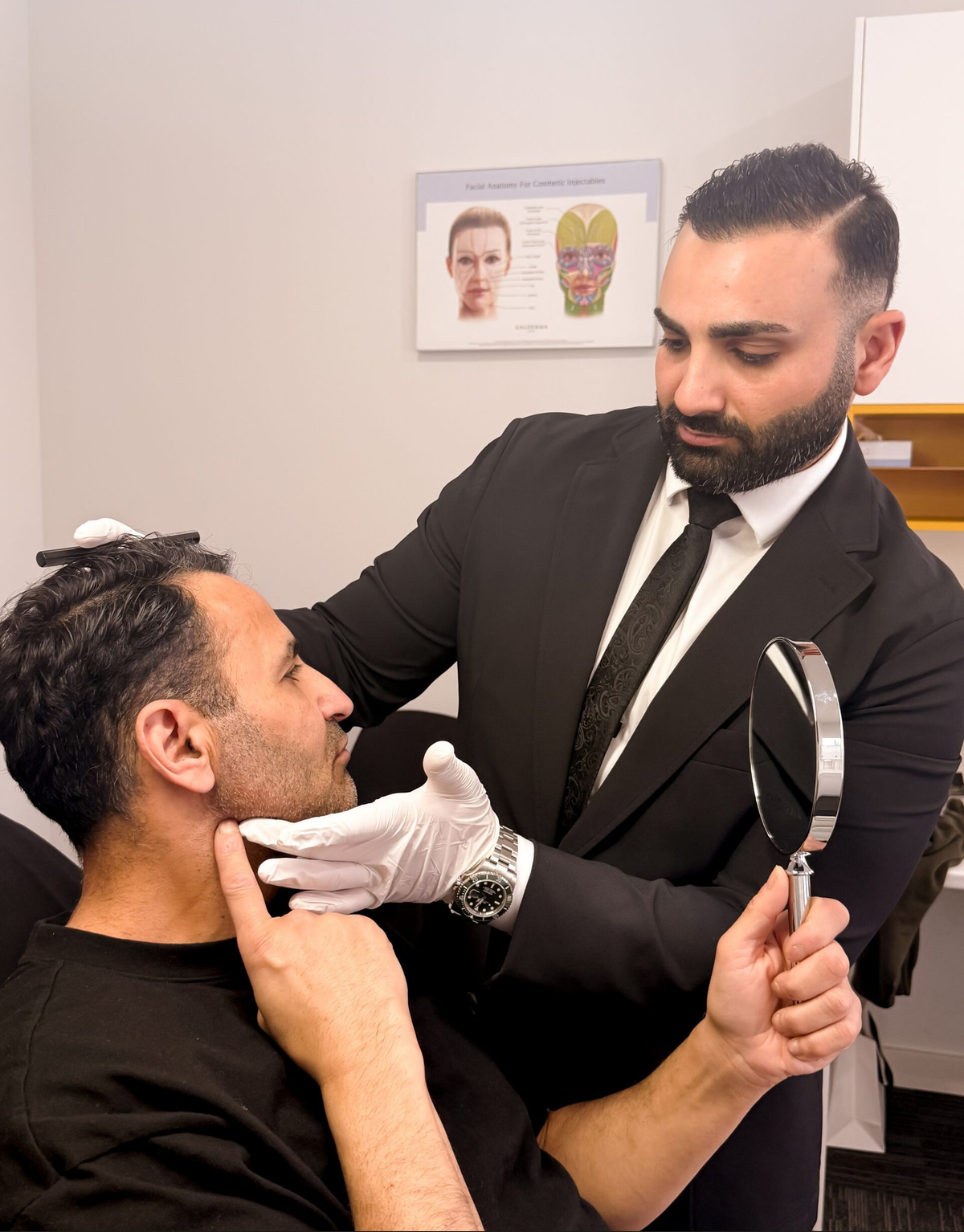
The masseter is examined at rest and on clenching, its size and symmetry assessed, along with the cheek and tongue signs and lower-face proportion.
03

Information

Whether the pattern fits awake or sleep bruxism, what belongs with a dentist, whether a sleep assessment is warranted, what a cosmetic assessment can and cannot contribute, risks, alternatives and the option of proceeding with nothing.
04

Decision

You are not asked to decide on the day. Time to consider information is part of informed consent.
15  /  Location

Jaw clenching assessment in
Melbourne: where the clinic is

The practice is in Glenroy, in the City of Merri Bek, roughly 13 kilometres north of the central business district. The clinic is on Glenroy Road, close to Glenroy Station on the Craigieburn line and the Pascoe Vale Road corridor.
Patients attend from Glenroy, Hadfield, Fawkner, Oak Park, Gowanbrae, Pascoe Vale, Coburg North, Broadmeadows, Campbellfield and Craigieburn.
16  /  Common Questions

Questions patients
ask

If your question is not answered here, ask it at your consultation. There is time set aside for exactly that.

Bruxism. It covers both clenching, which is static forced closure of the jaw, and grinding, which is dynamic movement of the jaw with the teeth in contact. It occurs in two forms: awake bruxism during the day, and sleep bruxism at night.

Jaw muscle fatigue or aching, tenderness at the angle of the jaw, headaches in the temples or on waking, tooth sensitivity or flattened teeth, a ridge along the inside of the cheek, scalloped edges on the tongue, and in some people a lower face that has become wider. Clicking or locking involves the joint rather than the muscle and belongs with a dentist or physiotherapist.

Awake bruxism is defined by lack of awareness. It is a stress and concentration response, and people commonly clench while focused, driving or working without noticing. Physical signs like a ridge along the inside of the cheek, indentations on the tongue, and afternoon jaw fatigue reveal it.

Current evidence says largely no. For years it was blamed on how the teeth meet, but recent studies suggest occlusal factors have minimal influence, and bruxism is now understood as driven by the nervous system as part of the sleep-wake cycle, particularly for the sleep form. Stress and sleep are the main drivers.

Most of it is not cosmetic. A dental occlusal device to protect the teeth, addressing the stress or habit driving it, a sleep assessment if it happens at night, and physiotherapy or oral medicine where the joint is involved. Where chronic clenching has enlarged the chewing muscle and widened the lower face, that muscle can be assessed at a cosmetic practice, but it addresses a consequence rather than the cause.

Sustained muscle contraction produces the same soreness as any overworked muscle, and the force also transmits through the teeth into the supporting structures. Pain in front of the ear, or clicking and locking, can involve the joint itself rather than the muscle, and that needs a dental or physiotherapy assessment.

You often cannot tell directly, but signs include waking with jaw tightness or headache, tooth sensitivity, worn teeth, or being told you grind by someone who shares your bed. A dentist can confirm it from the wear patterns on your teeth. If you also snore or wake unrefreshed, a sleep assessment may be warranted.

Yes. The masseter, the main chewing muscle at the angle of the jaw, enlarges with chronic heavy clenching, the way any muscle grows with repeated use. An enlarged masseter widens the lower face and squares the jaw. This is the one part of the picture a cosmetic assessment addresses.

A dentist for the diagnosis, the tooth damage and a protective night guard, since bruxism is diagnosed and dentally managed by a dentist. A doctor if your grinding disturbs your sleep or you snore, since that can point to a sleep breathing problem. A cosmetic assessment is relevant only for the enlarged muscle and lower-face width.

Sleep bruxism is associated with the arousal patterns of sleep and with sleep disorders including obstructive sleep apnoea. If you grind at night and also snore, wake unrefreshed, or have been told you stop breathing in your sleep, that should be assessed medically, as it matters more than the grinding itself.

Stress is the strongest established association, especially for awake bruxism. Studies link clenching to stress, anxiety and restlessness, and recent work points to the stress hormone cortisol as part of the mechanism. Managing stress is part of managing awake clenching.

A consultation fee applies and is confirmed when you book.

Related concerns

The lower face is assessed as a whole

Contour region
Mentalis region
Platysmal region
Medical condition
Dr Ibrahim Hawli
Written and clinically reviewed by
Dr Ibrahim Hawli, MBBS
Level 1 Certification, American Academy of Aesthetic Medicine. Advanced training in non surgical nasal assessment with Aesthetic Intelligence.
Last reviewed: [insert month year]  ·  Next review due: [insert month year]

Your first step is

an assessment.
This page provides general information about a condition and does not constitute medical advice. Bruxism is diagnosed and dentally managed by a dentist. Any medical approach carries risks. Individual outcomes vary and not all approaches suit all people. Where a sleep disorder or dental damage is suspected, assessment by the appropriate practitioner is recommended. Surgery is not performed at this practice. Any decision follows an individual consultation and assessment with a registered medical practitioner.