
Informed consent:
Informed consent is the legal and ethical foundation of any medical procedure. It is more than a form you sign. It is a process that begins when you first ask about a treatment and continues until, and after, the treatment is complete.
For cosmetic medical procedures in Australia, informed consent has specific requirements under the September 2025 AHPRA guidelines. This page explains what those requirements are, and what you should expect.
MBBS · Registered Medical Practitioner · Ahpra MED0002627622
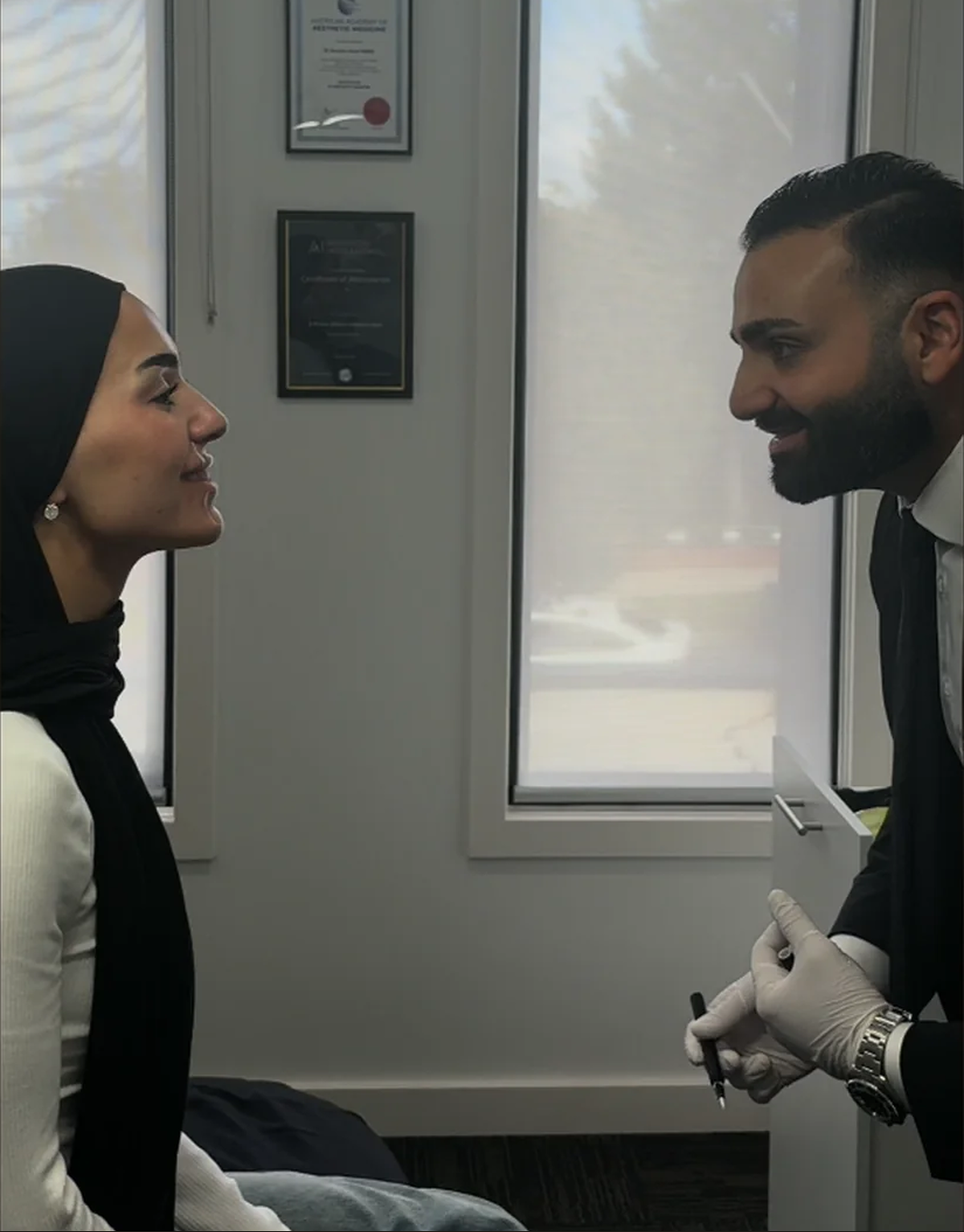
Informed consent means you have been given full information about a proposed procedure, including risks, benefits, alternatives, and the option of doing nothing, in plain language, with time to consider it, before agreeing to proceed. It must be documented in writing under the September 2025 AHPRA rules. For patients under 18, a mandatory seven-day cooling off period between consultation and procedure applies. You retain the right to withdraw consent at any point up to the procedure beginning, without justification.
Consent is a process,
not a signature
The common misunderstanding about consent is that it is completed at the moment you sign a form. It is not. Signing the form is the documentation of consent, not the consent itself.
Valid informed consent involves:
- A conversation in which the practitioner explains the proposed procedure and you ask questions
- Time to consider the information you have received
- The information itself in a form you can understand
- The ability to decline without pressure or penalty
- Written documentation of what was discussed and what was agreed
Any consent obtained by skipping any of the above is not valid consent, regardless of what the signed form says. A patient who was rushed, pressured, or not given full information has not consented in the legal sense.
The five elements of
valid informed consent
For consent to be legally and ethically valid, all five of the following must be present. If any element is missing, consent is not valid.
Capacity
You must have the mental capacity to understand, weigh, retain, and communicate your decision. Capacity is presumed in adults unless there is specific reason to question it.
Disclosure
You must have been given all information a reasonable person would want. Nature, risks, benefits, alternatives, and material information specific to your circumstances.
Understanding
You must actually understand, not simply have received the information. Plain language matters. Questions are welcomed. Interpreters arranged where needed.
Voluntariness
Your decision must be free from pressure, coercion, undue influence. This includes financial pressure (special pricing) and social pressure.
Documentation
Under September 2025 AHPRA rules, consent for cosmetic procedures must be documented in writing. Verbal consent alone is not sufficient.
The mandatory
cooling off period
Under the September 2025 AHPRA guidelines, a mandatory cooling off period applies to specific patient groups.
Between consultation and procedure. Applies without exception. No cosmetic procedure can be performed on a patient under 18 within seven days of the consultation at which the procedure was discussed.
No specific cooling off period mandated, but the right to time to consider information is protected as part of valid consent. At this practice, no adult patient is asked to decide on the day of consultation. Time to consider is offered as a matter of course, not because it must be requested.
Your right to withdraw
consent at any point
Consent, once given, is not permanent. You can withdraw it at any point up to the procedure beginning. Withdrawing consent is not a failure of the consent process. It is the consent process working properly.
Call or email the practice. No explanation is required.
Let reception or the practitioner know. The procedure will not proceed.
If having second thoughts as preparation proceeds, say so. Any preparation completed (numbing cream, cleansing) will simply be discontinued.
Handled consistently with consumer law. Withdrawal does not create a financial penalty for exercising your rights. Consultation fee for medical assessment already provided remains separate.
Consent cannot be withdrawn retrospectively, but you retain all other rights: complaint mechanisms, records access, and the right not to consent to any future procedure.
Consent for patients
under 18
Where a patient is under 18, additional protections apply under the September 2025 AHPRA framework. Cosmetic procedures on patients under 18 are approached with additional caution at this practice.
- Parent or legal guardian must attend both consultation and procedure. Both patient and parent/guardian must consent.
- Mandatory 7-day cooling off period between consultation and procedure, without exception.
- Specific consideration of age-appropriate procedures. Not all procedures are appropriate at every age.
- Additional documentation explicitly confirming cooling off, parental consent, and age-appropriateness assessment.
- Higher threshold for proceeding. Recommendation not to proceed is more frequent.
Consent that is
not valid
Being explicit about this is more useful than a general disclaimer. Consent is not valid in any of these circumstances.
Obtained under pressure
Time-limited offers, discounts contingent on booking today, verbal pressure from practitioner. All are pressure, and all invalidate consent.
Without adequate information
If risks, alternatives, or specific parameters were not discussed, the consent is not fully informed.
In an unfamiliar language
If patient does not speak English fluently, an interpreter must be provided. Family members interpreting is not adequate for medical consent.
For a different procedure
Consent is specific. A practitioner cannot obtain consent for one procedure and then perform a different or expanded procedure without additional consent.
From someone without capacity
If a patient lacks capacity for any reason (intoxication, cognitive impairment, medication effect), consent obtained from them is not valid.
Given by someone else without authority
A partner, family member, or friend cannot consent on behalf of a capable adult patient.
Where to raise
concerns
Raising a concern is your right. This practice supports it. You do not need permission from the practice to report.
Practice first
Contact the practice by phone or in writing. Response expected within reasonable time. Concern should be documented.
0404 342 222
info@tajmeelcliniq.com.au
Ahpra
Australian Health Practitioner Regulation Agency accepts notifications about registered practitioners.
1300 419 495
ahpra.gov.au
HCC Victoria
Independent statutory body handling health service complaints in Victoria.
1300 582 113
hcc.vic.gov.au
OAIC
Office of the Australian Information Commissioner. For concerns about handling of personal health information including photographs.
1300 363 992
oaic.gov.au
Questions patients
ask about consent
If your question is not answered here, ask it at your consultation.
Informed consent is a process, not just a signature. It requires that you have full information about a proposed procedure (nature, risks, benefits, alternatives, doing nothing), in plain language, with time to consider, before agreeing. Under the September 2025 AHPRA rules, it must be documented in writing.
For each specific procedure. General consultation is documented separately. Consent for a specific procedure is documented at the point that procedure is agreed, in writing, with the specific parameters recorded.
Yes. You retain the right to withdraw consent at any point up to the procedure beginning, without justification. Withdrawal does not create a penalty for exercising your rights.
For patients under 18, a mandatory seven-day cooling off period between consultation and procedure applies under the September 2025 AHPRA guidelines, without exception. For adults, no specific cooling off period is mandated, but the right to time to consider is protected as part of valid consent.
The nature of the procedure, the specific parameters, the realistic outcome, the risks (common, less common, uncommon, rare-serious), the alternatives including doing nothing, the aftercare, and confirmation that you can decline. All in plain language, with time to consider, and documented in writing.
Only in specific circumstances: for a patient under 18, a parent or legal guardian must consent alongside the patient. For an adult who lacks capacity, a legal decision-maker may consent. A capable adult must consent for themselves.
An interpreter must be arranged for a formal medical consent discussion. Family members interpreting is not adequate. This is arranged at booking; let the practice know.
Consent to a procedure and consent to use of photographs are separate. Photographs for clinical records only are covered by general consultation consent. Photographs for publication or advertising require separate, specific written consent.
Raise directly with the practice first. If not resolved, contact Ahpra (1300 419 495), the Health Complaints Commissioner Victoria (1300 582 113), or the OAIC for privacy concerns. You do not need permission from the practice.
Cosmetic practice
in Glenroy, Melbourne
Level 1, 10 Glenroy Road, Glenroy VIC 3046. Close to Glenroy Station on the Craigieburn line and the Pascoe Vale Road corridor.
Consulting hours: Sunday, Monday, Wednesday, Thursday, 10:00 to 17:00.

Registered medical practitioner, Ahpra registration MED0002627622. Level 1 Certification, American Academy of Aesthetic Medicine.
Last reviewed: [insert month year] · Next review due: [insert month year]
Consent is a process.
This page provides general information about informed consent for cosmetic medical procedures and does not constitute individual legal or medical advice. Consent processes and documentation are individualised at consultation. Under the September 2025 AHPRA framework, written consent is mandatory for cosmetic procedures. Surgery is not performed at this practice. Any decision to proceed follows an individual consultation and assessment with a registered medical practitioner.