
Consultation

Cosmetic consultation: what happens,

and what you should expect
A consultation is a clinical appointment, not a sales meeting. Its purpose is to establish what is actually happening in your face, whether anything should be done about it, and whether this practice is the right place for it.

Some consultations end with a plan. Some end with a recommendation to do nothing. Some end with a referral to a different practitioner. All three are legitimate outcomes.
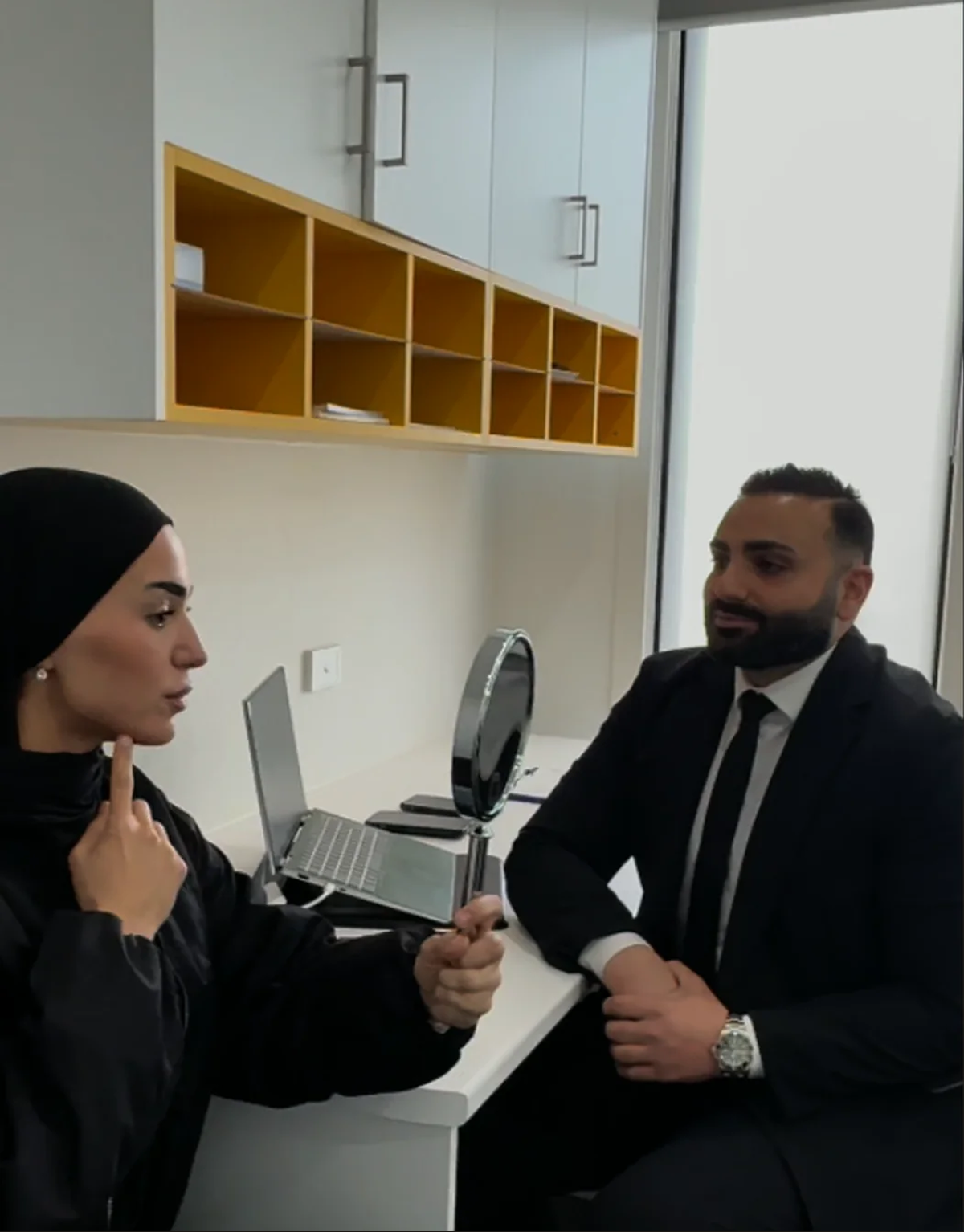
Dr Ibrahim Hawli
MBBS  ·  Registered Medical Practitioner  ·  Ahpra MED0002627622
tajmeel-consultation
In short
A consultation runs 30 to 45 minutes with the treating doctor. It covers your history, an examination of the area concerned, and a discussion of what is clinically appropriate including the option of nothing. Risks and alternatives are explained in plain language, both verbally and in writing. You are not asked to decide on the day. A consultation fee applies and is confirmed at booking. No referral is required to attend.
01  /  Why It Matters

Why assessment comes
before anything else

Most people arrive having already decided what they want. That is reasonable, and it is usually based on something they have read or seen.
The difficulty is that the thing a person notices and the thing actually causing it are frequently different.
What people notice
What is often happening
A fold that looks like a wrinkle
Often a structural boundary, not a crease
A neck band that looks like loose skin
Often a muscle edge that has separated
A jawline that seems to have softened
Often obscured from above rather than lost
A chin that looks dimpled
Either a muscle pulling on skin, or a bone feature present since birth
These are different findings with different answers. Establishing which one you have is not a formality before treatment. It is the part that determines whether anything will work.
An examination also catches what a photograph cannot. Tissue quality, muscle activity, tethering points and anatomical variants are established by hand and by watching a face move. None of that is visible in an image, which is why this practice does not assess from photographs.
02  /  Your Practitioner

Who you
will see

Your consultation is with him directly. The assessment, the discussion of options, and the consent conversation are all conducted by the treating practitioner rather than delegated.
You will see Dr Ibrahim Hawli, MBBS, a medical practitioner registered with the Australian Health Practitioner Regulation Agency. His registration can be verified on the public register at ahpra.gov.au.
Qualification
MBBS, registered medical practitioner
Ahpra registration
MED0002627622, verifiable on the public register
Certification
Level 1 Certification, American Academy of Aesthetic Medicine
Further training
Advanced non surgical nasal assessment, Aesthetic Intelligence
Surgery is not performed at this practice. Where a surgical, dental, orthodontic or other specialist opinion is the appropriate course, that is what will be recommended.
03  /  The Appointment

What happens at a
cosmetic consultation

The appointment has four parts and runs 30 to 45 minutes. Photographs may be taken as a clinical record, in standard views and where relevant both at rest and in animation. Clinical photographs are retained in your record and are not used for advertising.
01

History and discussion

What you have noticed, when it changed, and what you are hoping for. Your medical history, current medications, any previous cosmetic work, and anything relevant such as recent weight change, dental history or sleep pattern.
02

Examination

The area is examined at rest and in movement. Depending on the concern this includes palpation of tissue quality, assessment of muscle activity, measurement of proportion rather than estimation, and checking symmetry between sides.
03

Information

What the examination found, what is driving it, what is clinically appropriate, the realistic outcome, the risks, the alternatives including doing nothing, and whether another practitioner is better placed to help. The longest part of the appointment.
04

Decision

You are not asked to decide during the appointment. You leave with the information and the time to consider it.
04  /  Assessment

What is
assessed

The specifics vary by concern, and each concern page on this site sets out its own assessment list. Common to all of them are the following.
Where the history or examination suggests a medical cause rather than an age related change, investigation of that cause takes priority. Several of the concerns assessed here have red flag patterns that point toward a general practitioner, a dentist or a specialist, and those are raised directly.
05  /  What You Will Be Asked

The questions you will
be asked, and why

Some of these surprise people, so it is worth explaining the reasoning.
When did you first notice it
Gradual onset over years and sudden onset over weeks point to different causes. Sudden change in particular deserves attention.
Does it change through the day, or with expression
This separates dynamic findings from established ones, which changes what is realistic.
What medications are you taking
Several medications affect bleeding, healing, muscle function or sweating. This is a safety question.
Have you had cosmetic work before
Previous work affects both anatomy and what is appropriate now. Approximate dates help even if the details are missing.
Has your weight changed recently
Facial fat compartments respond to weight change, and a recent shift can explain a great deal.
Do you have a photograph from several years ago
The most useful thing you can bring. It establishes a baseline that memory cannot.
What are you hoping for
Not a sales question. The answer determines whether the expectation and the achievable outcome are the same thing, and if they are not, that is the most important conversation in the appointment.
Why now
Sometimes the answer is simply that it has been on your mind. Sometimes it relates to an event, a relationship or a period of stress. Both are legitimate, and a practitioner is expected to understand the motivation behind a request.
06  /  What You Should Ask

The questions

you should ask
You are entitled to ask these of any practitioner, including this one. If a clinic is reluctant to answer any of them, that is informative.
A practitioner who answers these openly is demonstrating something a testimonial cannot.
07  /  Consent

Informed consent,
in plain language

Consent is not a form you sign on the way in. It is a conversation with a defined content, and the regulatory requirements are specific about what it must include.
Under the guidelines that took effect in September 2025, consent must be obtained in both verbal and written form, in plain language, and the discussion must cover the risks, the benefits and the alternatives. The discussion itself must be documented.

You should leave able to explain, in your own words

If you cannot explain those things after the appointment, the consent conversation was not complete. That is a reasonable standard to hold any practitioner to.
You may also withdraw consent at any point, including after you have signed and before anything is performed. That does not require a reason.
08  /  Your Time

Your right to time
before deciding

This practice does not ask you to decide on the day, and there is a principle behind that rather than a policy.
Time to consider information is part of informed consent. A decision made in the room, immediately after receiving a large amount of new information, is not a considered decision. It is a reaction.
Patients under 18
A cooling off period of at least seven days between informed consent and any non surgical cosmetic procedure is mandatory under the current guidelines, and no money is payable until after that period other than for the initial consultation.
For adults, this practice applies the same principle by choice. You will not be asked to commit during the consultation, and you will not be offered a reason to hurry. If you want to think about it for a week, a month or indefinitely, that is the expected response rather than an inconvenience.
The guidelines also encourage patients to discuss their reasons for wanting a cosmetic procedure with an independent registered health practitioner during that period. Your general practitioner is a reasonable person to have that conversation with, and this practice supports it.
09  /  The Honest Part

When the recommendation
is to do nothing

This happens, and it is worth saying plainly on the page you will read before booking.
Some consultations end with the conclusion that nothing should be done. The reasons vary.

The finding is not what was assumed

The thing the patient wants changed would not respond to any available approach.

The anatomy makes it unachievable

Attempting it would produce a result the patient did not ask for.

The first step belongs elsewhere

To a dentist, a general practitioner or a surgeon rather than here.

Intervening would create a problem

Where the concern is smaller than the patient believes, and none currently exists.
And sometimes the reason is the expectation rather than the anatomy. Where someone arrives wanting to look like a specific other person, or where the motivation suggests an underlying difficulty that a cosmetic procedure will not address, proceeding would not be in their interest. The guidelines require a practitioner to refer to an appropriate independent practitioner where an underlying psychological condition is identified or suspected that would make someone an unsuitable candidate. That is not a judgment of the patient. It is what a responsible practitioner is required to do.
A consultation that ends this way is not a wasted appointment. You leave knowing what is actually happening and why nothing should be done about it, which is more valuable than a treatment that was never going to work.
10  /  Patients Under 18

If you are
under 18

The guidelines are specific about patients under 18, and this practice follows them.
The guidelines also note that certain prescription cosmetic procedures are inappropriate for this age group, and this practice does not perform them on patients under 18. Advertising cosmetic procedures to anyone under 18 is prohibited, and nothing on this site is directed at that audience.
11  /  Preparation

What to bring

The photograph is the single most useful item. Memory is unreliable about faces, including your own, and a baseline image frequently changes the conversation.
12  /  Fees

Fees and what is included

A consultation fee applies and is confirmed when you book. It covers the appointment time, the examination, the clinical record and the discussion of options.
The fee is charged for the consultation itself, as a clinical service. It is not conditional on proceeding with anything, and there is no financial advantage to you in deciding to proceed. That is deliberate. A consultation fee that is refunded or discounted on the condition of booking a procedure creates an incentive to proceed, which is the opposite of what an assessment is for.
Where a procedure is appropriate and you decide to proceed, the total cost is confirmed in writing before anything is performed.
No referral is required to attend. Where your concern turns out to have a medical rather than cosmetic cause, a referral to the appropriate practitioner will be provided.
13  /  Location

Where the clinic is

The practice is in Glenroy, in the City of Merri Bek, roughly 13 kilometres north of the Melbourne central business district. The clinic is on Glenroy Road, close to Glenroy Station on the Craigieburn line and the Pascoe Vale Road corridor.
Patients attend from Glenroy, Hadfield, Fawkner, Oak Park, Gowanbrae, Pascoe Vale, Coburg North, Broadmeadows, Campbellfield and Craigieburn.
Address
Level 1, 10 Glenroy Road, Glenroy VIC 3046
Phone
Hours
Sunday, Monday, Wednesday and Thursday, 10am to 5pm
To book, call or email the clinic. Appointments are by arrangement.
14  /  Common Questions

Questions patients
ask

If your question is not answered here, ask it at your consultation. There is time set aside for exactly that.

The appointment runs 30 to 45 minutes and has four parts: a discussion of your history and what you have noticed, an examination of the area at rest and in movement, an explanation of what was found along with risks and alternatives, and then time to decide. You are not asked to commit on the day.

No. You can book directly. Where your concern turns out to have a medical cause rather than a cosmetic one, a referral to the appropriate practitioner will be provided.

No. A consultation fee applies and is confirmed when you book. The fee covers the appointment, the examination and the clinical record, and it is not conditional on proceeding with anything.

Dr Ibrahim Hawli, MBBS, a registered medical practitioner, Ahpra registration MED0002627622. The assessment and the consent discussion are conducted by him directly.

No. You are not asked to decide during the appointment, and you will not be given a reason to hurry. Time to consider the information is part of informed consent.

Ask about qualifications and registration number, who will perform any procedure, what is actually causing your concern, the realistic limits, the risks including uncommon ones, the alternatives including doing nothing, what happens if there is a complication, the full recovery timeline, and the total cost. A practitioner who answers these openly is telling you something useful.

That is a legitimate outcome and it happens. Sometimes the finding is not what was assumed, sometimes the anatomy makes the desired result unachievable, and sometimes the appropriate first step belongs to a dentist, a general practitioner or a surgeon. You will leave understanding why.

Yes, at any point before anything is performed, and without giving a reason.

As long as you want. For patients under 18 a cooling off period of at least seven days between consent and any procedure is mandatory. For adults this practice applies the same principle by choice.

No. Tissue quality, muscle activity, tethering points and anatomical variants are established by examination and by watching a face move. None of that is possible from an image.

Before you book

Read about your concern first

Each concern page sets out what is actually happening, what the assessment covers, and in several cases a self test you can do before you arrive.
Lower perioral region
Contour region
Platysmal region
Mentalis region
Perioral region
Periorbital region
Medical condition
Full list
Dr Ibrahim Hawli
Written and clinically reviewed by
Dr Ibrahim Hawli, MBBS
Registered medical practitioner, Ahpra registration MED0002627622. Level 1 Certification, American Academy of Aesthetic Medicine. Advanced training in non surgical nasal assessment with Aesthetic Intelligence.
Last reviewed: [insert month year]  ·  Next review due: [insert month year]

Assessment first.

Everything else after.

This page provides general information about cosmetic medical consultations and does not constitute medical advice. Any cosmetic medical procedure carries risks. Individual outcomes vary and not all people are suitable candidates. Surgery is not performed at this practice. Any decision follows an individual consultation and assessment with a registered medical practitioner.