
Concerns  /  Lips and Lower Face  /  Jawline Definition

Jawline definition: what actually
changes, and what does not
A jawline that used to be sharp and is no longer is usually explained in one of two ways: you have gained weight, or your skin has loosened. Both can be true. Neither is the main event.
The bone that forms your jawline changes shape measurably with age, and it has been mapped in detail.
Dr Ibrahim Hawli
MBBS  ·  Registered Medical Practitioner
Jaw Clenching
In short
The jawline is formed by the mandible, and the mandible remodels throughout life. The gonial angle, which determines how sharply the jaw turns upward at the back, measures around 160 degrees at birth, reduces to approximately 120 by adulthood, then opens again with age. Imaging shows the angular prominence at the corner of the jaw flattens by up to 3 mm and ramus height reduces by around 4 to 5 mm across a lifetime. Soft tissue descent from above obscures what remains. Body fat percentage matters more than any exercise, and the popular jaw-strengthening advice is either unsupported or works against the goal.
01  /  Two Searches, One Phrase

Two different questions,
one phrase

People searching for jawline definition are asking one of two things, and they need different answers.
Question one

What is the jawline, exactly?

A definitional question. The answer is anatomical, and it is the first half of this page.
Question two

How do I get a sharper jawline?

A practical question. The answer involves bone, muscle, fat and skin in that order of importance.
Most content answers the second badly because it skips the first. If you do not know what forms the line, you cannot know what changed.
02  /  Anatomy

What the jawline
actually is

The visible jawline is the lower border of the mandible, seen through overlying tissue. The mandible is a U-shaped body projecting forward, and at each posterior end sits a gonial angle, from which the ramus extends vertically upward. The point at the corner itself is the gonion.
Three measurements determine how a jawline reads. Over the bone sits the masseter, a chewing muscle that inserts onto the outer surface and contributes bulk at the angle. Over that sit fat compartments, then skin.
01

The gonial angle

The angle at which the lower border of the body meets the posterior border of the ramus. A more acute angle produces a sharper corner. A more obtuse angle produces a softer, rounder one.
02

Ramus height

The vertical dimension of the jaw at the back. Taller ramus, longer visible jaw line.
03

Bigonial width

The distance between the two gonial angles, which determines how wide the lower face reads from the front.
So the line you see is bone shape, plus muscle bulk, plus overlying tissue thickness, plus skin. Four variables, and only one of them is fat.
03  /  The Timeline

The gonial angle
across a lifetime

This is the part almost nobody knows, and it reframes the whole subject.
The angle sharpens for two decades, holds, then opens back up. Read the sequence and the softening you are noticing starts to make sense.
160°
At birth
A newborn jaw is almost flat at the corner.
140°
By age four
Teeth have formed and the mandible has elongated and widened, reducing the angle.
120°
By adulthood
The most acute the angle will ever be.
Opens
With age
Radiographic studies show the angle increasing again, becoming more obtuse.
The jawline you had in your twenties was the sharpest your jaw would ever be, and the softening you are noticing is the bone returning toward where it started.
That is also why the gonial angle is used for age estimation in the identification of skeletal remains. It is a reliable enough marker of age that forensic scientists work backward from it.
04  /  The Evidence

What the imaging data
shows about the bone

An artificial intelligence assisted shape analysis of mandibular ageing produced the most specific figures available.
The front of the jaw holds up better than the back. Anterior body height remained relatively stable with ageing in both women and men, with P values of 0.9 and 0.61.
Gonion projection flattens by
up to 3 mm
Ramus height, women
69.75 → 64.47 mm
Ramus height, men
76.65 → 72.45 mm
Statistical significance
P < 0.001
Resorption concentrated in
condylar region, coronoid process, inferior border
Anterior body height
relatively stable
That last finding is clinically useful. The chin region is relatively conserved while the corner and the height at the back reduce. So a jawline commonly loses its angle and its vertical dimension before it loses anything at the front, which matches what patients describe when they say the jaw looks shorter or rounder rather than smaller.
05  /  Honest Uncertainty

Where the evidence
disagrees

Two findings from good studies point in opposite directions, and a page that presents only one is being selective.
Study one

The jaw gets wider

A widening trend across intercondylar, interrami and bigonial widths with ageing, more pronounced in men. In older men, mandibular body length increased by approximately 5.8 mm.
Study two

The jaw gets narrower

Analysing 2,699 panoramic radiographs of patients aged 19 to 69, general trends showed the gonial angle increasing with age while bigonial width and ramus height decreased.
Both studies agree the angle opens. They disagree on whether the jaw gets wider or narrower.
A third study adds another layer. In complete denture wearers, gonial angle size did not correlate with age, edentulous period or ridge resorption at all, but did correlate positively with increased masseter muscle activity. The honest position is that mandibular ageing is directional in some respects and variable in others, that population and dental status affect it, and that your jaw is measured rather than assumed.
06  /  Bone Quality

Bone shape and bone quality
are two different things

Alongside the outline changing, the bone forming it changes internally. A study of 300 panoramic radiographs measured cortical width and cortical erosion against age.
Age correlated negatively with cortical width, at r equals minus 0.522, and positively with cortical erosion, at r equals 0.388. In plain terms, the outer shell of the bone thins and becomes more eroded with age. That is separate from the shape changing, and it happens at the same time.
07  /  Sex Differences

Men and women lose it differently

A woman noticing her jawline softening is often watching an already-obtuse angle become more so, while a man is often watching a projection flatten. Different starting points, different trajectories, and treating them as the same problem produces the wrong plan.
08  /  What Works

How to define jawline:

what the research supports
This is the query with the most misinformation attached, so here is the separation.
What genuinely matters

Body fat percentage

The single largest modifiable variable. Overlying tissue thickness is one of the four factors determining how the line reads, and it is the one you can change most. There is no exercise that reduces fat in a specific area.

Skin quality and sun protection

Skin laxity contributes, and ultraviolet exposure accelerates it. Daily sun protection to the jaw and neck is worthwhile and routinely missed.

Posture and head position

Not for the reason usually claimed. A forward head position changes how the jawline and submental area read in photographs and in a mirror, without changing anything anatomical.

Addressing what sits above the jaw

Descending tissue obscures the jawline from above. That is often the actual finding.
What does not do what people think

Mewing

The claim is that sustained tongue posture reshapes the adult jaw. The mechanism cited is real, that masticatory muscle force influences bone. What that evidence describes is bone responding to substantial, sustained loading during growth and development. No controlled evidence demonstrates reshaping an adult mandible by resting the tongue against the palate.

Chewing gum and jaw exercisers

These do work on the masseter, and that is the problem. The masseter responds to load by hypertrophying. A larger masseter adds bulk at the angle, which widens the lower face rather than sharpening it. For anyone whose concern is a wide or square lower face, this advice makes it worse. Gonial angle has been shown to correlate positively with increased masseter activity.

Facial exercises for the jawline generally

No controlled evidence supports reshaping the mandible in adulthood.
The pattern is consistent. Muscle load does influence bone, over long timescales and mostly during growth. It does not let an adult renovate their own jaw from the outside.
09  /  The Long View

What jaws looked like
before food got soft

This is the strongest evidence that muscle load shapes bone, and it also shows the timescale on which it works.
There is a strong connection between the strength of the masticatory muscles and the dimensions of the craniofacial complex, with changes in biomechanical force and muscular strength influencing and altering the underlying bony tissue.
279
Skeletons examined
From medieval and post-medieval London, males and females analysed separately.
Nearly all
Measurements reduced
Statistically significant reductions were observed in nearly all post-medieval measurements.
Softer food
The proposed reason
Dietary change after the Industrial Revolution required less chewing.
That is a real effect of muscle load on bone. It operated across generations and across whole populations, through childhood development, not through an adult chewing gum for six months.
If you want the honest version of the jaw-exercise argument, this is it. The mechanism is genuine. The timescale is not one you can act on.
10  /  Connected Areas

The jawline also
disappears from above

An assessment that looks only at the jaw is incomplete, because the line is often obscured rather than lost.
Tissue descending from the cheek accumulates and stops at the mandibular ligament, forming a jowl that sits over the jaw border. In front of it a shallow dip forms. The jawline underneath may be largely intact while the outline reading to an observer is interrupted.
This is why the jawline, the marionette line and the prejowl region are assessed together. A jaw that has lost its angle is a different finding from a jaw that has been covered over, and the two are frequently present at once in different proportions.
Below the jaw, submental fullness and changes in the platysma alter the boundary between face and neck, which affects how sharply the jawline reads from the side even when the bone is unchanged.
11  /  Assessment

What a jawline
assessment covers

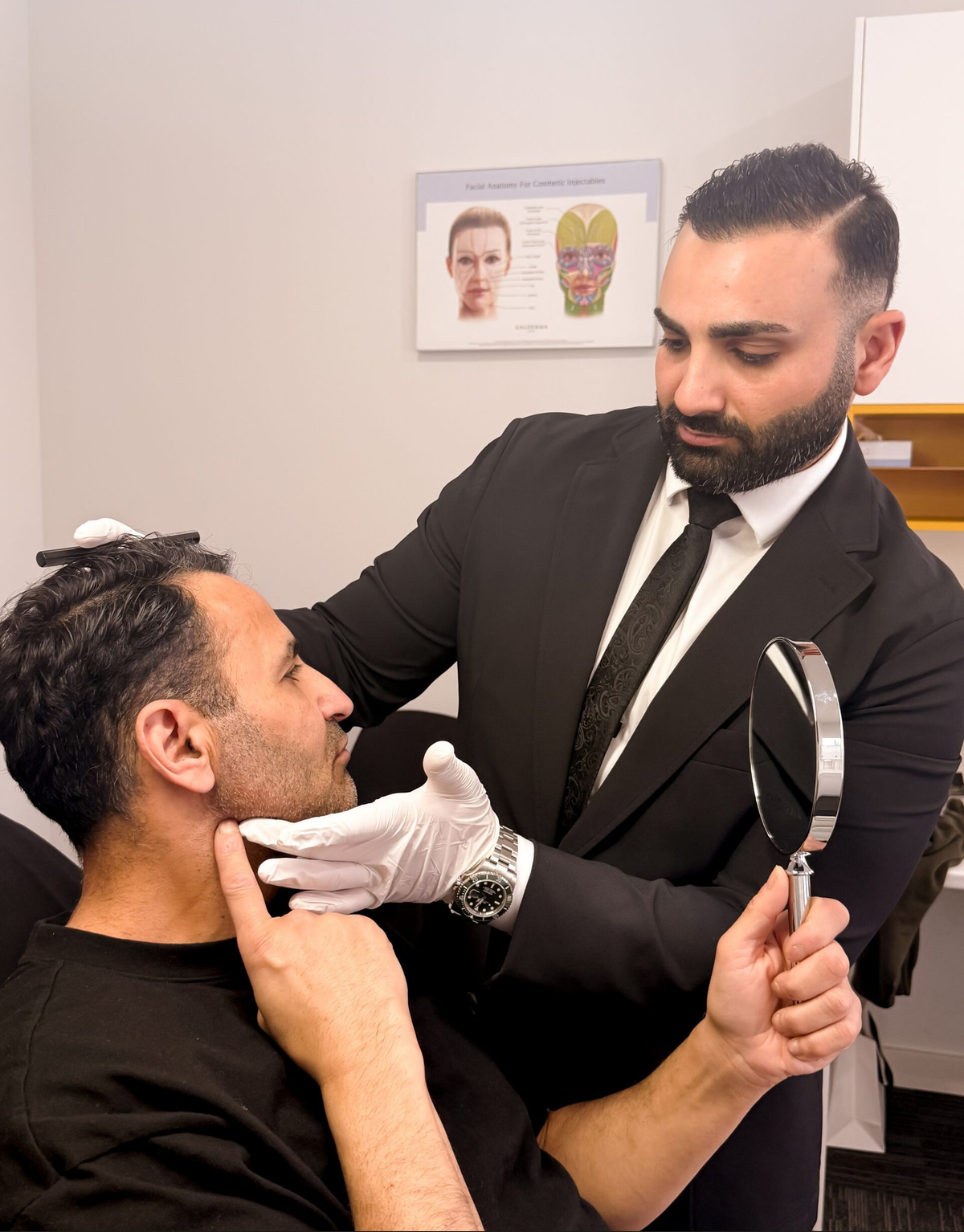
Photographs may be taken as a clinical record, in standard front, oblique and side views, and are not used for advertising.
12  /  Before You Decide

What to know before
your consultation

Every option carries potential risks as well as potential benefits, and no cosmetic medical procedure is risk free. Vascular and nerve structures run close to the lower border of the jaw, which is why this area is treated with anatomical caution and examined in person.
Bring a list of your current medications, details of any dental or orthodontic history, and a photograph from several years ago if you have one.
Where the finding is skeletal, a non-surgical approach addresses the appearance rather than the cause. Surgery is not performed at this practice, and referral is the recommendation where surgery, orthodontics or dental treatment is the appropriate course.
Assessed at consultation

Factors that may make an approach inadvisable

Individual results vary. Not all people are suitable candidates. In some cases the appropriate recommendation is that nothing be undertaken.
13  /  What Happens

What happens at your consultation in Glenroy

Appointments run 30 to 45 minutes. A consultation fee applies and is confirmed when you book. No referral is required to attend.
01

Discussion

What you have noticed, when it changed, recent weight change, dental and orthodontic history, medical history, current medications and previous cosmetic work.
02

Assessment

The jaw is examined from front, oblique and side, at rest and on clenching, with palpation along the border, assessment of masseter bulk, jowling, submental fullness and skin quality.
03

Information

Whether the change is bone, muscle, overlying tissue, skin or a combination, what is clinically appropriate, whether referral is the better course, risks, alternatives and the option of proceeding with nothing.
04

Decision

You are not asked to decide on the day. Time to consider information is part of informed consent.
14  /  Location

Jawline assessment in Melbourne:
where the clinic is

The practice is in Glenroy, in the City of Merri Bek, roughly 13 kilometres north of the central business district. The clinic is on Glenroy Road, close to Glenroy Station on the Craigieburn line and the Pascoe Vale Road corridor.
Patients attend from Glenroy, Hadfield, Fawkner, Oak Park, Gowanbrae, Pascoe Vale, Coburg North, Broadmeadows, Campbellfield and Craigieburn.
15  /  Common Questions

Questions patients
ask

If your question is not answered here, ask it at your consultation. There is time set aside for exactly that.

The visible lower border of the mandible, seen through overlying tissue. How sharp it reads depends on four things: the gonial angle at the corner, the height of the jaw at the back, the bulk of the masseter muscle over the angle, and the thickness of the fat and skin above it.

Usually a combination. The gonial angle opens with age, making the corner rounder. Imaging shows the angular prominence at the corner flattens by up to 3 mm and the height of the jaw at the back reduces by around 4 to 5 mm across a lifetime. Tissue descending from the cheek then obscures what remains.

There is no controlled evidence that sustained tongue posture reshapes an adult mandible. The mechanism people cite, that muscle force influences bone, is real, but the evidence for it describes substantial sustained loading during growth and development, not adult tongue positioning.

It enlarges the masseter, which adds bulk at the angle and widens the lower face. If your concern is a wide or square lower face, it works against you. Gonial angle has been shown to correlate positively with increased masseter activity.

Not for reshaping bone. There is no controlled evidence supporting facial exercise as a way to alter the adult mandible. Body fat percentage and skin quality are the modifiable variables that actually affect how the jawline reads.

Yes, and the evidence is striking. A study of 279 medieval and post-medieval London skeletons found statistically significant reductions in nearly all post-medieval mandibular measurements, attributed to softer food requiring less chewing. Muscle load does shape bone. It operates across generations, not across months.

Often both, in different proportions, plus descending tissue from above and skin laxity. Establishing the proportion is the purpose of an assessment, because a bone finding, a fat finding and an obscured jawline call for entirely different answers.

Yes. Women have a significantly wider gonial angle at baseline, so they are often watching an already-soft corner soften further. Men start with greater ramus height and bigonial width and a more projecting corner, and the widening trend with age is more pronounced in men.

A consultation fee applies and is confirmed when you book.

Related concerns

The lower face is assessed as a whole

Lower perioral region
Mentalis region
Platysmal region
Bruxism
Dr Ibrahim Hawli
Written and clinically reviewed by
Dr Ibrahim Hawli, MBBS
Level 1 Certification, American Academy of Aesthetic Medicine. Advanced training in non-surgical nasal work with Aesthetic Intelligence.
Last reviewed: [insert month year]  ·  Next review due: [insert month year]

Your first step is

an assessment.
This page provides general information about cosmetic medical consultations and does not constitute medical advice. Any cosmetic medical procedure carries risks. Individual outcomes vary and not all people are suitable candidates. Surgery is not performed at this practice. Any decision follows an individual consultation and assessment with a registered medical practitioner.