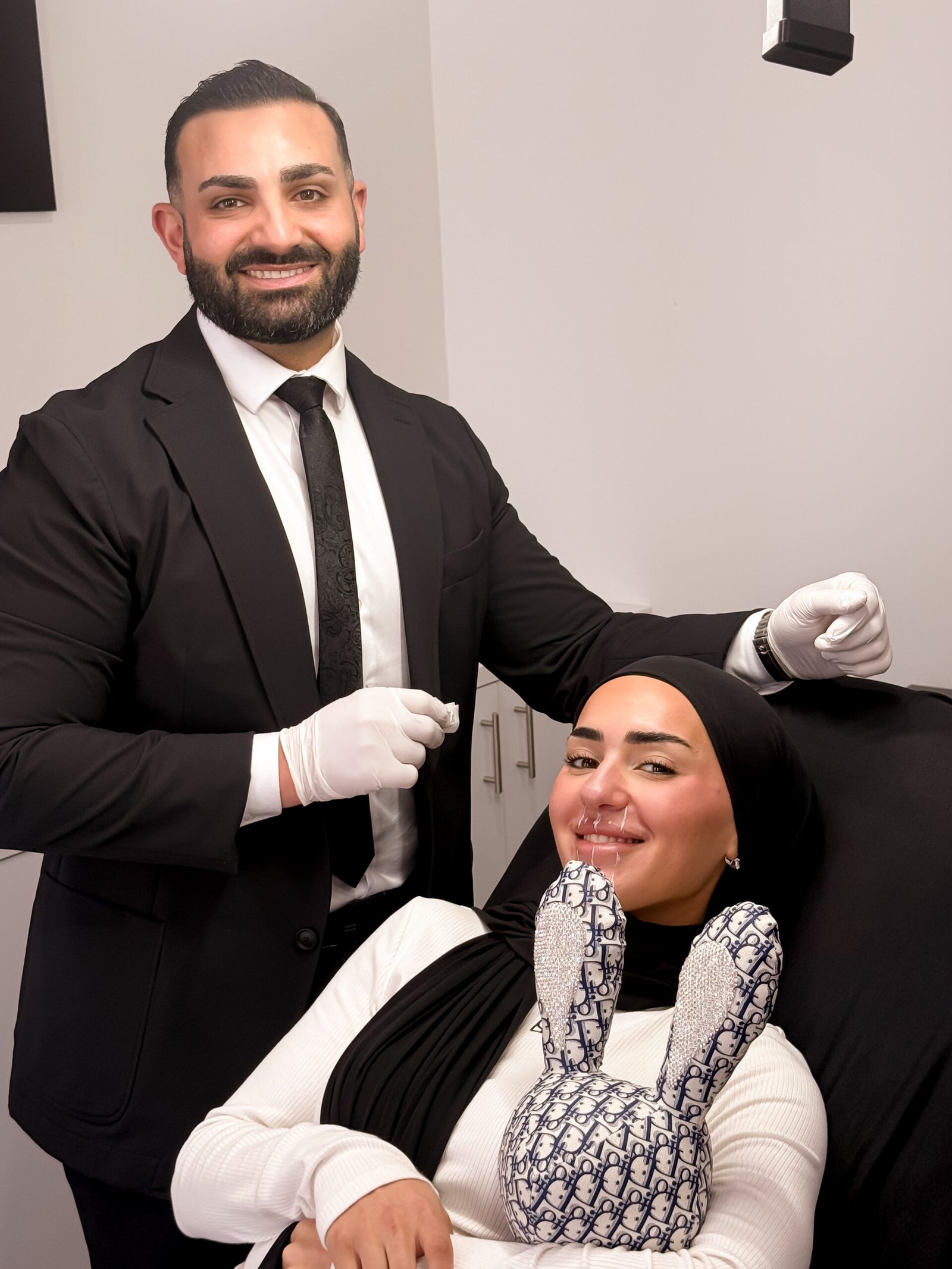
Concerns  /  Facial Lines  /  Bunny Lines

Bunny lines: what they are

and why they appear
The fine diagonal creases that appear across the upper sides of the nose when you scrunch, smile or squint are known as bunny lines. Clinically they sit in the nasoglabellar region.
This page explains what they are, which muscles produce them, why they sometimes become noticeable after other areas of the face have been addressed, and what recent anatomical research has changed about the region.
Dr Ibrahim Hawli
MBBS  ·  Registered Medical Practitioner
Ahpra registration MED0002627622
Dr Ibrahim Client
In short
A bunny line is an oblique crease on the upper lateral nose, produced mainly by the transverse part of the nasalis muscle with assistance from the levator labii superioris alaeque nasi. Some people have them naturally, sometimes from childhood. In others they become noticeable after the frown area has been addressed, because the nasalis compensates. Whether anything is appropriate for you can only be determined by examination.
01  /  Definition

What are bunny lines
on the face

They are oblique wrinkles that run across the upper lateral nasal bridge, appearing when you smile, squint or scrunch the nose. They radiate outward from beside the inner corner of the eye and down along the nasal sidewall.
Not everyone develops them. They are less common than frown lines or forehead creases, and in some people they are simply part of a characteristic expression, sometimes visible since childhood. Many people find them appealing rather than a problem, which is a legitimate reason to leave them alone.
Four muscles converge here
Transverse nasalis
Main mechanical driver
Levator labii sup. alaeque nasi
Lifts the upper lip
Procerus
Sits above, pulls brow down
Orbicularis oculi
Inner fibres, lateral border
02  /  Origin

What causes bunny lines wrinkles

Clinical writing on this area distinguishes two origins, and the distinction changes the conversation entirely.
Primary

Part of your natural expression

Reported more frequently in people who are highly expressive, who wear heavy spectacle frames, who have chronic rhinitis and scrunch the nose habitually, and who have light coloured eyes and narrow the lids against bright light. Australian sun exposure makes that last group larger here than in most countries.
Secondary

Becoming noticeable after the frown area is addressed

Clinical literature describes this as a compensatory effect. When the procerus and corrugator muscles are less active, the nasalis appears relatively more active and, in some people, begins contracting more strongly during the same expression. Published sources describe three distinct patterns emerging within the first four weeks.
This develops most often in women who already had a faint suggestion of these creases and who spend time outdoors.
This is relevant to your consultation. If you are being assessed for the frown area, this possibility should be part of the discussion beforehand rather than a surprise a month later.
03  /  Current Research

What recent research changed about this region

Understanding which muscle is producing a crease, rather than looking only at where the crease appears, is the difference between an anatomical approach and a cosmetic one.
Journal of Cosmetic Dermatology

The bunny triangle

A multimodal study combining cadaveric dissection with dynamic ultrasound found the region where these creases appear is not sitting on top of a discrete muscle at all. The researchers described a muscle free interval, bordered by the procerus above and medially, the transverse nasalis above and laterally, the levator labii superioris alaeque nasi below and medially, and the inner fibres of the orbicularis oculi laterally.
Ultrasound during active nose scrunching showed the visible wrinkle corresponds to skin folding over that non muscular region while the surrounding muscles contract at its edges. The nasalis thickened dynamically in most participants, confirming it as the main mechanical driver.
39
Cadaveric dissections
Anatomical mapping of the region and its muscular borders.
13
Ultrasound volunteers
Dynamic imaging during active nose scrunching.
0
Muscles under the crease
The wrinkle forms over a non muscular interval.
The finding matters because it changes where a practitioner focuses during assessment. It is also the kind of detail that separates a practitioner tracking current anatomical literature from one following a diagram learned years ago.
04  /  Anatomy and Care

Why this region requires
particular care

This is the most functionally sensitive small area of the upper face.
The levator labii superioris alaeque nasi lifts your upper lip. It sits immediately below and lateral to where nasal creases appear. Anything affecting that muscle’s action can produce an asymmetric smile or a temporarily lowered upper lip.
Published clinical guidance is consistent. Work in this region should stay high on the nose and medial, and keep clear distance from the inner corner of the eye. Creases extending laterally away from the bridge should not be chased, because that is where the lip elevator lies.
The aim is never to eliminate movement of the nose. You should still be able to scrunch it. None of this can be judged from a photograph, a video call or a description over the phone.
05  /  Assessment

How bunny lines on the nose are assessed

What is clinically appropriate for you, if anything, is discussed during that appointment.
06  /  Prevention

What slows these creases
becoming established

These measures address the causes rather than the appearance, and are worth doing regardless of whether you pursue anything else.

Have your vision checked

Squinting recruits these muscles. Uncorrected vision and screen glare produce hours of contraction daily without you noticing.

Daily sun protection

Australia records among the highest ultraviolet levels globally. UV degrades the collagen and elastin that allow skin to flatten after each contraction.

Address nasal irritation

Chronic rhinitis and habitual nose scrunching increase the volume of movement in this region. Treating the underlying irritation reduces it.
07  /  Before You Decide

What to know before your consultation

Every option carries potential risks as well as potential benefits, and no cosmetic medical procedure is risk free. In this region the specific consideration is proximity to the muscles that lift the upper lip, which is why a conservative approach and in-person examination matter.
Risks, alternatives and expected recovery are explained during your appointment, in person, before any decision is made.
Assessed at consultation

Factors that may make this inadvisable

Bring a list of your current medications, and tell your doctor about any previous cosmetic work on the frown area, upper lip or nose.
Individual results vary. Not all people are suitable candidates. In some cases the appropriate recommendation is that nothing be undertaken.
08  /  What Happens

What happens at your consultation in Glenroy

Appointments run 30 to 45 minutes. A consultation fee applies and is confirmed when you book. No referral is required.
01

Discussion

What you have noticed, whether it followed previous work elsewhere, your medical history, current medications and any prior cosmetic procedures.
02

Assessment

The nasal area is examined at rest, during scrunching and in full smile. Upper lip symmetry, muscle pattern and the relationship to the frown area are assessed.
03

Information

What is clinically appropriate, what it involves, expected timeline, risks, alternatives and the option of proceeding with nothing.
04

Decision

You are not asked to decide on the day. Time to consider information is part of informed consent.
09  /  Service Area

Assessment for patients across Melbourne's northern suburbs

Tajmeel Cliniq is on Glenroy Road, close to Glenroy Station and the Pascoe Vale Road corridor. Patients attend from Glenroy, Oak Park, Pascoe Vale, Hadfield, Gowanbrae, Fawkner, Broadmeadows, Moonee Ponds, Campbellfield, Craigieburn and Roxburgh Park.
The clinic is on Level 1. Street parking is available on Glenroy Road and adjacent side streets. Sunday and Monday appointments suit patients who cannot attend during a standard working week.
Tajmeel Cliniq
Level 1, 10 Glenroy Road, Glenroy VIC 3046
0404 342 222
info@tajmeelcliniq.com.au
Opening hours
10  /  Common Questions

Questions patients ask
about bunny lines

If your question is not answered here, ask it at your consultation. There is time set aside for exactly that.

An oblique crease across the upper side of the nose that appears when you scrunch, smile or squint. It is produced mainly by the transverse nasalis muscle, with a contribution from the muscle that lifts the upper lip.

This is a recognised compensatory effect. When the frown muscles are less active, the nasalis appears relatively more active and some people begin recruiting it during the same expression. Clinical literature describes these patterns emerging within the first four weeks. It should be discussed beforehand.

Not necessarily. Many people have them from childhood as part of their natural expression. They also appear in people who wear heavy glasses, who have chronic rhinitis, or who squint frequently in bright conditions.

Reducing the habitual movement helps. Having your vision checked matters, because squinting recruits these muscles. Daily sun protection slows the loss of skin elasticity that allows creases to become established.

The muscles that lift your upper lip sit immediately below the region. Their position varies between individuals and can only be examined directly.

A consultation fee applies and is confirmed when you book. Call 0404 342 222.

Related concerns

Upper face areas are assessed together

Glabellar region
Frontalis region
Periorbital region
Full assessment
Dr Ibrahim Hawli
Written and medically reviewed by
Dr Ibrahim Hawli
MBBS. Level 1 Certification, American Academy of Aesthetic Medicine. Advanced training in non surgical rhinoplasty with Aesthetic Intelligence.
Ahpra registration MED0002627622. Dr Hawli practises cosmetic medicine at Tajmeel Cliniq in Glenroy, Melbourne, and conducts every consultation in person.
Last reviewed: [insert month year]  ·  Next review due: [insert month year]

Your first step is

an assessment.

0404 342 222  ·  Level 1, 10 Glenroy Road, Glenroy

This page provides general information about cosmetic medical consultations and does not constitute medical advice. Any cosmetic medical procedure carries risks. Individual outcomes vary and not all people are suitable candidates. Any decision follows an individual consultation and assessment with a registered medical practitioner. Dr Ibrahim Hawli, Ahpra registration MED0002627622.