
Medical disclaimer
This page explains what the information on this website is, what it is not, and when you should stop reading it and see a doctor instead.
Last updated: [insert month year]
MBBS · Registered Medical Practitioner · Ahpra MED0002627622
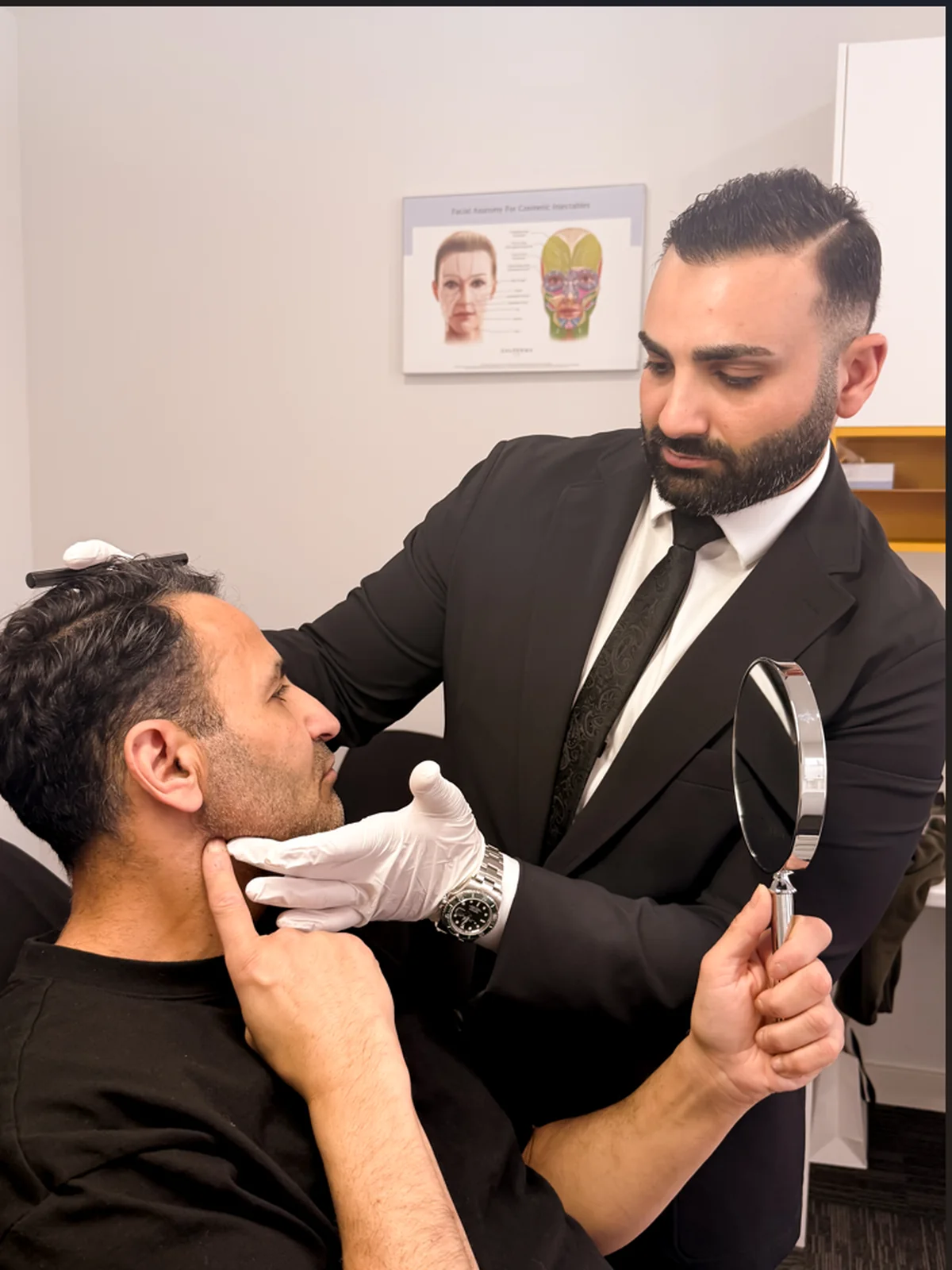
Everything on this site is general information. It is not an assessment of you, not a diagnosis, and not a recommendation for your situation. Reading it does not make you a patient here.
If you have a skin lesion, patch, mole or bump that is new, changing, persistent, bleeding, itching or not healing, see a general practitioner or dermatologist. Some of those changes are pre-cancerous or cancerous and look identical to ordinary texture concerns. No cosmetic content, here or anywhere, substitutes for that assessment.
If you are experiencing a medical emergency, call 000.
When to stop reading
and see a doctor
These are specific, and they are the reason this page is longer than a paragraph.
- A mole or spot that has changed in size, shape, colour or border
- A lesion that bleeds, crusts, or does not heal within a few weeks
- A rough or scaly patch on sun-exposed skin that persists or keeps returning, particularly face, ears, scalp, hands or forearms
- A new lump or bump that is growing
- A sore present for more than a month
- Persistent redness with texture change in the central face
- Scaly, itchy patches that recur or worsen
- Any skin change that is worrying you and that you have been putting off
Rough scaly patches on sun-exposed skin can be actinic keratoses, which are pre-cancerous and can progress to squamous cell carcinoma. To a patient they look and feel like dry, textured skin. Australia has among the highest skin cancer rates in the world. A cosmetic website that discusses skin texture without saying this clearly is contributing to a real problem.
- You are pregnant or breastfeeding and considering any procedure
- You take medication affecting bleeding, healing or immunity
- You have an autoimmune condition, bleeding disorder, or are immunocompromised
- You have a history of keloid or hypertrophic scarring
- You have taken isotretinoin in the past twelve months
- You are unsure whether a concern is cosmetic or medical
Seeing a GP first does not close any door. It means the cosmetic conversation, if you still want it, starts from a safe position.
Emergencies
Do not wait for a clinic to open. Do not email. Do not search for reassurance online. Emergency symptoms need an emergency response.
- Difficulty breathing, throat or tongue swelling
- Sudden facial droop, arm weakness, speech difficulty
- Sudden vision changes, vision loss, or eye pain
- Widespread hives with dizziness or collapse
- Severe unexplained chest pain
- Loss of consciousness
- Skin turning white, purple or grey near a treated area
- Cool skin with pain out of proportion
- Spreading redness with warmth and discharge
- Fever above 38 degrees within 48 hours of a procedure
- Rapidly worsening swelling
The full set of thresholds, including what is normal after a procedure and what is not, is on Risks and Safety.
What this
website is
This site exists to give people considering cosmetic medical treatment enough accurate information to have a useful conversation, and to recognise when what they have noticed needs a different kind of appointment.
- General explanations of common concerns and how they are usually approached
- Honest descriptions of what approaches can and cannot achieve
- The risks, including uncommon and serious ones
- The circumstances in which a procedure would not be recommended
- The regulatory framework, your rights, and complaint pathways
- Practical information about attending this practice
It is written to be useful before you book anywhere, including at a different practice.
What this
website is not
- Not medical advice about you. Nothing here was written with knowledge of your history, medications or skin.
- Not a diagnosis. Several unrelated conditions produce similar appearances, and some are serious.
- Not a treatment recommendation. That depends on findings only an examination produces.
- Not a substitute for your GP. For anything that might be medical, that is the correct first appointment.
- Not complete. Absence of something here does not mean it does not apply to you.
Not a reason to delay medical assessment. This is the one that matters most. If reading a page here leads someone to decide that a change they have noticed is probably just texture and can wait, this site has done harm rather than good.
Why general information
cannot substitute for assessment
This is worth explaining rather than asserting, because the reason is specific to this field.
The same visible change can have completely different causes in different people. Roughness on the cheeks might be photoageing, or keratosis pilaris, or seborrhoeic dermatitis, or early actinic damage. Asymmetry might be normal anatomical variation, or dental, or muscular, or neurological. A page describing what usually causes something cannot tell you what is causing yours, because that requires looking at you.
Assessment also covers things you would not think to mention. Medication interactions, skin type and how it affects risk, previous procedures and what they did to the tissue, scarring history, and findings on examination that the patient had not noticed. None of that is available to a web page.
And the appropriate recommendation is frequently not the one the reader expected. Sometimes it is a different procedure. Sometimes it is skincare rather than a procedure. Sometimes it is referral to a different practitioner. Sometimes it is that the concern is within normal variation and does not need treating. A page cannot make that judgement.
No practitioner-patient
relationship
Reading this website, sending an enquiry, or submitting a booking request does not create a practitioner-patient relationship and does not make you a patient of this practice.
That relationship begins when you attend an in-person consultation and an assessment is undertaken. Until then, no duty of care in respect of your individual clinical situation arises, because no assessment has occurred.
This is why we cannot answer clinical questions about your specific situation by phone or email before you have been assessed. If that seems unhelpful, the alternative is worse: advice given without an examination, about a situation nobody has looked at.
See Terms of Use for the full position and The Consultation Process for what an actual assessment involves.
How our clinical content is
written and reviewed
Stating this openly is part of what makes the general information here worth reading at all.
- Written and clinically reviewed by Dr Ibrahim Hawli, MBBS (Ahpra MED0002627622). Clinical pages carry his name as author and reviewer, not a generic practice byline.
- Sourced from primary material: AHPRA guidelines, TGA guidance, peer-reviewed clinical literature, Australian government health resources. Where a figure is given, it comes from somewhere.
- Written to state limits, not just possibilities. Several pages cover what an approach cannot achieve and where claims commonly exceed the evidence.
- Compliant with the September 2025 AHPRA advertising guidelines, which is why there are no prices, before-and-after imagery, testimonials or product brand names on this site.
- Reviewed and dated. Every clinical page shows when it was last reviewed and when the next review is due.
No content is generated and published without clinical review. Where research tools are used in preparing material, the clinical content is reviewed and approved by Dr Hawli before publication, and responsibility for it sits with him.
Why review dates are on
every clinical page
Medicine changes. Guidelines change. The September 2025 AHPRA framework changed a substantial amount of what applies to cosmetic practice in Australia, and material written before that date can now be wrong in ways that are not obvious to a reader.
Every clinical page carries a review date. That date tells you when a registered practitioner last checked the page against current guidance.
Content can still be out of date between reviews. If you find something here that appears inconsistent with current guidance, or that contradicts what a practitioner has told you, tell us and we will check it.
Regulatory requirements described on this site are Australian, and in places specifically Victorian. If you are outside Australia, different rules apply and this site is not a guide to them.
"Individual results vary"
and what that means
This phrase appears on every cosmetic website and has been reduced to noise. What it actually means:
- Outcomes differ between people with similar presentations. Anatomy, skin type, tissue quality, age, healing response, medications and lifestyle all affect the result.
- Outcomes differ for the same person over time. A result achievable at 35 may not be at 55.
- Some people are not suitable candidates at all. Not as a formality. Real contraindications exist.
- A result you have seen elsewhere may not be achievable for you. Different starting anatomy produces different endpoints.
- Nothing here should be read as a promise of any outcome, and no practitioner can honestly guarantee one.
AI summaries, search snippets
and reproductions elsewhere
This section exists because it is now a real issue rather than a theoretical one.
Search engines, AI assistants and other automated systems increasingly summarise web content and present those summaries to users directly. Content from this site may appear in such summaries.
We do not control those summaries. A summary can lose context, drop a qualification, combine information from unrelated sources, or omit the safety information that made the original accurate. A shortened version of a page here may be misleading even where the page itself is not.
If you have read a summary rather than the page, read the page. Particularly for anything involving risks, contraindications, or when to seek medical assessment. Those are exactly the parts most likely to be compressed away.
The same applies to reproductions elsewhere. Where content from this site appears on another website, in a social media post, or in a forum, we cannot vouch for its accuracy, currency or completeness in that setting.
The authoritative version is the page on this site, with its review date. If something attributed to this practice appears inconsistent with what is published here, what is published here is what we stand behind.
Questions about
your own situation
If you have a question about your own skin, your own concern, or your own suitability for a procedure, the answer is a consultation rather than a page.
- For anything that might be medical: see your general practitioner. That is the correct first appointment and is generally Medicare-rebated where a cosmetic consultation is not.
- For an emergency: call 000.
- For a cosmetic assessment: see The Consultation Process for what is involved, or contact the practice.
Dr Ibrahim Hawli, MBBS
Registered medical practitioner, Ahpra MED0002627622
Verify registration at ahpra.gov.au
Where the detail sits
Urgent care thresholds, general risks, complaint pathways
What an actual assessment involves
Practitioner scope, advertising rules, recovery questions
Website terms, consumer rights, liability position
Tajmeel Cliniq,
Glenroy Melbourne
Level 1, 10 Glenroy Road, Glenroy VIC 3046
0404 342 222 · info@tajmeelcliniq.com.au
Consulting hours: Sunday, Monday, Wednesday, Thursday, 10:00 to 17:00
General information.
This medical disclaimer applies to all content published on tajmeelcliniq.com.au. Information on this website is general and does not constitute individual medical advice, diagnosis or treatment recommendation. No practitioner-patient relationship is created by use of this website. Clinical content is written and reviewed by Dr Ibrahim Hawli, MBBS (Ahpra MED0002627622) and carries a review date. Regulatory requirements described are Australian and in places specifically Victorian. Surgery is not performed at this practice. If you are experiencing a medical emergency, call 000.