
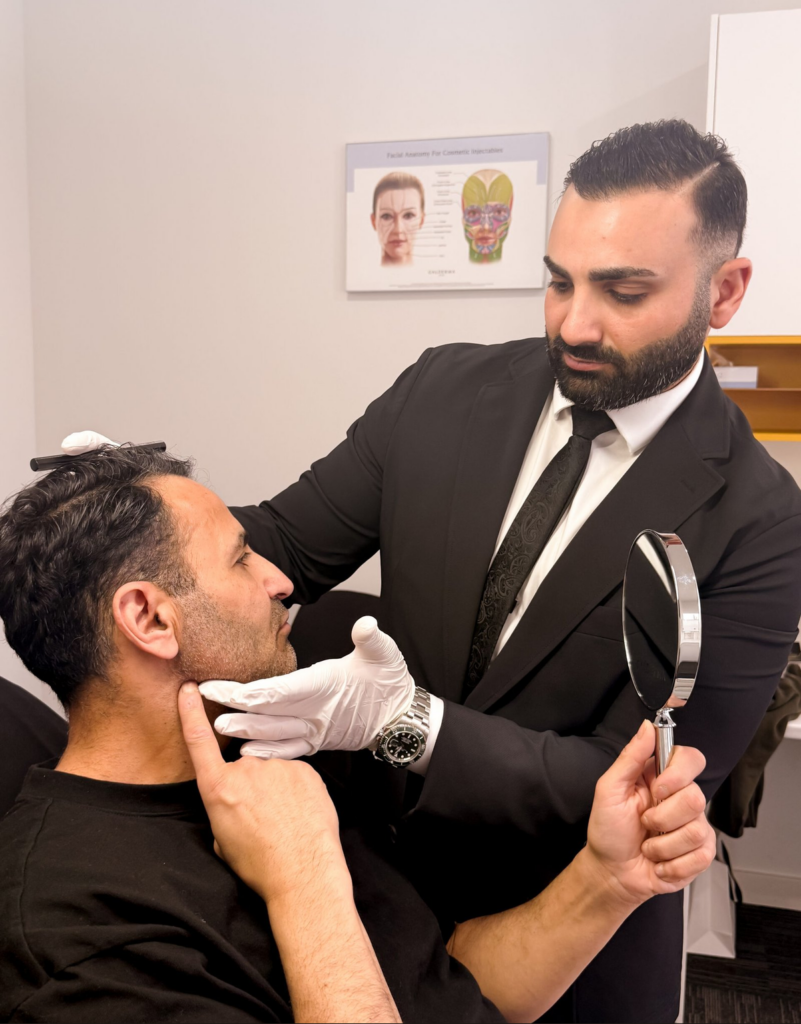
Jaw pain from clenching feels like one problem. Anatomically it is three, and they are separate.
Muscle pain, tooth pain and joint pain each come from different structures under load, each mean different things about what is happening, and each need a different practitioner to sort out. Getting the wrong one investigated first is common, and it is why a lot of jaw pain sits unresolved for years.
This article explains what is producing the pain, how to tell which of the three you have, and what to do about it. If you have not read the main page on jaw clenching yet, the jaw clenching concern page covers the underlying condition. This article focuses on the pain itself.
Written and clinically reviewed by Dr Ibrahim Hawli, MBBS. Tajmeel Cliniq, Glenroy, Melbourne.
The three sources of jaw pain from clenching
When people describe “jaw pain from clenching”, they usually mean pain somewhere in the region between the ear and the chin. Underneath that region there are three separate structures capable of producing pain, and clenching loads all three.
Muscle pain comes from the chewing muscles themselves, mostly the masseter at the angle of the jaw and the temporalis running across the side of the head. Muscle pain feels dull, spread out, and it worsens with activity. Tenderness on palpation is a give-away.
Tooth pain comes from the force transmitted through the teeth into the ligament that holds each tooth in its socket. That ligament is inflamed by sustained loading, which is why teeth can ache, feel sensitive or feel loose after prolonged clenching, without any decay being present.
Joint pain comes from the temporomandibular joint itself, the hinge in front of your ear that lets your jaw open and close. Joint pain is often sharper, more localised, and frequently comes with clicking, popping or a sensation that the joint is not moving smoothly.
Most people with clenching pain have some combination, usually one dominant with the others contributing. Working out which is dominant is the first step, because the answer sends you to a different practitioner.
Muscle pain: the most common and the most straightforward
Muscle pain from clenching behaves like muscle pain anywhere else in the body. Sustained contraction produces soreness, the muscle becomes tender to touch, and the pain settles when the muscle rests.
Where you feel it. At the angle of the jaw, on either side of the face, or across the temples on the side of the head. Both sides are usually affected, though one may be worse. Pain often builds through the day if you clench while awake, or is worst on waking if you clench in your sleep.
How to check it yourself. Place your fingers on the fleshy part of the cheek just in front of your ear, then bite down and release. You should feel a muscle bulging under your fingers. That is the masseter. Now press firmly into it with your fingertips while the jaw is relaxed. If it is tender, that is muscle pain contributing.
Do the same test on the temples, above and slightly in front of the ear. That is the temporalis.
What it means. The muscle is working too hard. The clenching itself is the cause. Reducing the clenching reduces the muscle load, and the pain follows.
What to do. Start by paying attention. Awake clenching is often unconscious, and the first useful step is to notice when you are doing it. Check your jaw position several times a day. If your teeth are touching, they should not be. In rest, the upper and lower teeth should be slightly apart, with the lips closed and the tongue resting on the roof of the mouth. Learning that resting position, and returning to it whenever you catch yourself, is the closest thing to a self-help intervention that works.
If the clenching is happening in your sleep, awareness will not help, because you are not awake to intervene. That is where a dental splint comes in.
Tooth pain: when the pain travels through the teeth
Teeth are not solid. Each tooth sits in a socket, held there by a thin layer of ligament called the periodontal ligament. That ligament is loaded with sensory nerves, and it registers sustained pressure as inflammation.
Where you feel it. Aching in the teeth themselves, often in the upper and lower back teeth on both sides. Sometimes described as “all my teeth hurt”, which is genuinely what it feels like. Sensitivity to cold or pressure is common, and some patients say specific teeth feel loose or high in the bite.
How to check it yourself. Tap gently on individual back teeth with a metal spoon handle. If several are tender in a symmetric pattern, particularly the molars, ligament inflammation from clenching is the likely cause. If one tooth is far more tender than the others, that is a dental issue in that specific tooth and needs a dentist regardless.
What it means. Clenching is being transmitted through the bite. The teeth are absorbing forces they are not designed for.
What to do. This is a dental problem and it needs a dentist. Two reasons. First, a dentist can rule out decay, fractures and abscess, which produce similar symptoms and cannot be dismissed without an examination. Second, a properly fitted occlusal device, a custom splint or night guard, is the intervention that actually protects the teeth from further loading. Over-the-counter mouthguards are not the same thing and can make things worse if they fit badly.
If you have tooth pain from clenching, the dentist is not a step you can skip. It is where the assessment has to start.
Joint pain: when the hinge is the problem
The temporomandibular joint sits directly in front of the ear. You can feel it by placing your fingers there and opening your jaw. The bumps you feel moving are the joint.
Inside the joint is a small disc of cartilage that separates the ball of the jaw from the socket. When that disc slips or wears, the joint stops moving smoothly, and pain, clicking and restricted movement follow.
Where you feel it. Directly in front of the ear, one side or both. Pain is often sharper than muscle pain, more localised, and worse with chewing or opening wide.
Signs it involves the joint.
- Clicking or popping when you open or close your jaw
- The jaw catching or locking briefly on opening
- Restricted opening, meaning you cannot fit three fingers stacked vertically between your upper and lower front teeth
- A sensation that the two sides do not open together
- Pain that changes when the jaw moves in specific directions rather than just when biting hard
What it means. The joint itself is involved, not just the muscle. That may be from clenching putting excess load on the joint over years, from the disc being displaced, or from a separate condition affecting the joint. It requires assessment.
What to do. Joint problems need a dentist with an interest in temporomandibular disorders, an oral medicine specialist, or a physiotherapist trained in this area. This is not a cosmetic concern and it is not something a cosmetic assessment can address. Ignoring joint symptoms and pursuing cosmetic reduction of the muscle alone leaves the underlying joint problem unassessed.
If your jaw clicks, locks or hurts specifically at the joint, that is your first referral.
How to tell which one you have
Read the three descriptions above and see which best matches. Often it is a combination, and that is fine. The rough guide:
- Dominant muscle pain: dull ache in the cheek muscles or temples, tender to firm pressure, worse through the day or on waking, no dental sensitivity, no clicking
- Dominant tooth pain: aching in the teeth themselves, sensitivity to cold or pressure, several teeth affected symmetrically
- Dominant joint pain: sharper pain in front of the ear, clicking or locking, worse on movement, restricted opening
If you have signs of more than one, you probably have more than one, which is common. Address the loudest first, but do not ignore the others.
Why “just stop clenching” is bad advice
Clenching is not something most people are consciously choosing. Awake clenching is usually a stress response operating below awareness. Sleep clenching happens outside conscious control entirely, tied to the arousal patterns of sleep.
Telling someone to stop clenching is like telling someone with a nervous habit they did not know they had to just not do it. It sounds reasonable and it does not work.
What does work, for the awake form, is building awareness of the resting jaw position and returning to it. That takes weeks of noticing. For the sleep form, awareness does nothing, and management involves protecting the teeth with a splint and addressing the sleep itself where relevant, particularly if snoring or unrefreshed waking is also present.
Sleep-related bruxism is also linked to obstructive sleep apnoea, which is a medical condition that matters considerably more than the grinding. If your partner tells you that you stop breathing during sleep, or you wake tired despite full sleep, that needs a doctor, not a cosmetic clinic.
Who to see first
The dentist first, in almost every case.
The dentist confirms that clenching is happening, rules out other dental causes of your pain, assesses the state of your teeth, and fits an occlusal device that protects the teeth. That last part is not optional if tooth wear is present, because enamel does not grow back.
If joint symptoms are prominent, you may need onward referral from the dentist to a colleague with specific interest in the temporomandibular joint, or to an oral medicine specialist, or to a physiotherapist trained in this area.
If sleep is disturbed, or if you snore heavily, add a general practitioner to the list. A sleep assessment may be warranted.
Where does a cosmetic medical practice fit? In one specific place, and only if you want it to. Years of heavy clenching enlarges the masseter muscle in the same way any muscle enlarges with repeated use. That enlargement widens the lower face and squares the jawline. If the appearance of that is a concern, and if the underlying clenching is being managed dentally, the muscle can be assessed. That is a cosmetic conversation, not a pain one, and it does not replace the dental management.
When jaw pain is not from clenching at all
Worth mentioning briefly, because the assumption that clenching is the cause can lead people to miss other things.
Sudden severe jaw pain, particularly with tingling or numbness, needs medical assessment. Jaw pain associated with chest discomfort or shortness of breath, particularly in adults with cardiac risk factors, is a well-known atypical presentation of heart trouble and needs urgent medical attention.
Jaw pain following a specific injury, jaw pain with a lump, jaw pain with fever, or jaw pain that has not settled over weeks needs a doctor. So does any pain that is progressive or waking you at night regardless of position.
These are uncommon causes. They are worth knowing about.
What to bring if you come for a consultation
If your pain is primarily muscle-related and you also want to discuss whether the muscle enlargement from years of clenching is contributing to the shape of your lower face, an assessment can cover both. Bring:
- Any dental assessment or splint you already have
- A summary of when the pain started and what makes it better or worse
- Details of any sleep issues, snoring or waking tiredness
- Your current medications
- A photograph of yourself from several years ago, if you have one
If your pain is primarily dental or joint-related, a dentist is the first stop. There is nothing useful this practice can add before that assessment.
In summary
- Jaw pain from clenching is three different things: muscle, tooth ligament, joint
- Which one is dominant decides who you should see, and the answer is almost always a dentist first
- Muscle pain can be partly self-managed by learning the resting jaw position and returning to it
- Tooth pain and joint pain need dental assessment and, in some cases, an occlusal device
- Joint symptoms may need oral medicine or physiotherapy referral
- Sleep-related grinding, especially with snoring, may point to a sleep breathing problem that needs medical assessment
- The cosmetic contribution is narrow and specific: assessing an enlarged chewing muscle where lower-face widening is a concern
Understanding the anatomy of the pain changes who you see, and it usually shortens how long it takes to get sorted.
If you are considering a cosmetic assessment for masseter-related lower-face widening, and your clenching is already being managed dentally, you can book a consultation with Dr Ibrahim Hawli. For diagnosis of the clenching itself, or for dental protection, a dentist is the appropriate practitioner.
Read the main concern page: Jaw clenching: why it happens and what actually helps
About the author: Dr Ibrahim Hawli, MBBS, is a registered medical practitioner at Tajmeel Cliniq in Glenroy, Melbourne. Ahpra registration MED0002627622, verifiable on the public register.
Reviewed: [insert month and year of publication] Next review due: [insert month and year 12 months later]